
Australian governments and major corporations use tendering to procure goods, services and construction work from competing suppliers. For businesses that sell to government agencies or large private-sector clients, tendering is often the formal process used to compete for that work.
Whether you’re a construction company eyeing infrastructure projects, a trade contractor hoping to work on government buildings, or a professional services firm targeting corporate clients, the tendering process is likely to play a significant role in your business growth.
Businesses new to tendering need to understand the process, requirements and documentation involved before deciding which opportunities to pursue. This guide explains how tendering works in Australia, including the types of tender you may encounter, what the process involves, what buyers ask for and how to prepare before you bid.
What does tendering mean?
In business, a tender is a formal written offer to supply goods, services or construction work at a stated price. Tendering is the competitive process a buyer runs to invite and compare those offers.
The client (often called the buyer, procurer, or principal) reviews all submissions and selects the one that offers the best value.
Tendering works like a structured job application: the buyer advertises what it needs, suppliers submit credentials and pricing, and the buyer selects the most suitable provider. However, unlike a typical job application, tendering involves detailed technical specifications, strict compliance requirements, and formal evaluation criteria.
The term “tender” can refer to both the process itself and the document you submit. When someone says they’re “responding to a tender” or “putting in a tender,” they mean they’re preparing a formal written proposal in response to a tender opportunity.
In this guide, “tendering” refers specifically to the procurement process used by organisations to invite and assess supplier offers.
What is common tendering terminology?
Understanding tender terminology helps you navigate documents and processes confidently:
- Approach to Market (ATM) – Any notice inviting potential suppliers to participate in a procurement
- Commonwealth Procurement Rules (CPR) – The framework governing federal government procurement
- Conforming vs Non-conforming – Whether a tender submission meets all mandatory requirements
- Evaluation Criteria – The standards used to assess and compare tender submissions
- Expression of Interest (EOI) – An initial call for interested suppliers to demonstrate their capabilities, often preceding a formal tender
- Panel or Standing Offer – Pre-qualified supplier arrangements where approved businesses can be directly engaged for specific work
- Request for Tender (RFT) – Formal invitation for suppliers to submit a tender
- Request for Quote (RFQ) – Similar to RFT but typically for simpler, lower-value procurements
- Value for Money – The core principle of government procurement, considering whole-of-contract benefits and costs, not just price
- Tenderer – A business or supplier that submits a tender response
- Addendum – An official amendment, clarification or update issued after the tender is released
- Conditions of tender – The rules and requirements that govern how a tender must be prepared and submitted
- Limited tender – A procurement approach where one or more selected suppliers are invited to respond rather than the opportunity being openly advertised
- Prequalification – A process used to assess suppliers before they are invited or permitted to tender for particular work
- Two-stage tendering / Early Contractor Involvement (ECI) – A process where a supplier may be engaged during an earlier stage before the final scope or price is fully established
Why do organisations tender and why do businesses bid?
Government agencies use competitive tendering processes to support transparent procurement and value for money. For government procurement, tendering serves several key purposes:
Ensuring fair competition
Every qualified business gets an equal opportunity to compete for government work, regardless of existing relationships or connections.
Achieving value for money
Competition between suppliers drives better pricing, quality, and innovation. However, “value for money” doesn’t simply mean the lowest price. It considers the whole-of-contract costs and benefits, including quality, risk, and long-term outcomes.
Maintaining transparency
The structured process creates a clear audit trail showing how decisions were made and why particular suppliers were chosen.
Meeting procurement obligations
Government entities must comply with Commonwealth Procurement Rules and relevant state-based procurement frameworks, which set requirements for how procurement processes are conducted.
Why do businesses bid for tenders?
For many Australian businesses, tendering represents a pathway to significant growth.
However, successful tendering requires investment:
- Time to identify suitable opportunities and prepare quality submissions
- Capability to deliver what you promise if successful
- Resources to maintain compliance systems and documentation
- Patience to build track record and refine your approach
Not every business should pursue tenders. Tendering makes most sense when:
- You have genuine capability to deliver the required scope
- The contract size aligns with your business capacity
- You understand and can manage the payment terms and cash flow requirements of the specific contract
- You’re prepared to meet compliance requirements
- You can sustain bid costs without guaranteed success
For businesses that commit to developing tendering capabilities, the rewards can be substantial: predictable revenue pipelines, opportunities to grow capacity, enhanced business systems, and improved market positioning.

What is the Australian tendering landscape?
Australia’s tendering environment operates across multiple levels, each with its own platforms, rules, and processes.
Federal Government Tendering
The Australian Government publishes all open business opportunities and awarded contracts on AusTender (www.tenders.gov.au). Federal procurement is governed by the Commonwealth Procurement Rules, which were updated with new rules coming into effect in November 2025.
Contracts valued above $10,000 (including GST) are published on AusTender’s Contract Notice List within 42 days of being awarded. This transparency requirement allows businesses to see what work is being awarded and to whom, helping you understand the market.
State and Territory Tendering
Each Australian state and territory operates its own tendering portal and procurement framework:
- NSW – buy.nsw / NSW eTendering
- Victoria – Tenders VIC (buyingfor.vic.gov.au)
- Queensland – QTenders
- Western Australia – Tenders WA
- South Australia – SA Tenders and Contracts
- Tasmania – Tenders Tasmania
- ACT – ACT Government Tenders
- Northern Territory – NT Government Tenders
While these portals vary in their specific features, they all serve the same fundamental purpose: advertising opportunities, facilitating tender submissions, and publishing contract awards.
Local Government Tendering
Australia’s local councils also procure goods and services through tenders.
Some use their state’s central platform, while others advertise through their own websites or specialist tender notification services.
Local government work can be particularly valuable for smaller businesses and local contractors.
Private Sector Tenders
Major corporations, particularly in construction, mining, and infrastructure, also issue tenders for significant contracts.
Private tenders may not appear on government portals but are often advertised through industry-specific platforms, professional networks, or directly to pre-qualified suppliers.
What types of tender will you encounter?
Understanding the different types of tendering methods helps you know what to expect when you encounter a tender opportunity.
Open Tendering
Open tenders are advertised publicly and any supplier that meets the stated eligibility criteria can respond, regardless of size or trading history.
This is the most common approach for federal and state government work, where agencies are generally required to test the market openly.
The advantage of open tendering is that it gives every business a fair opportunity. The challenge is that competition can be fierce, with dozens or even hundreds of businesses competing for the same contract.
Selective Tendering
Also called “invited tendering,” selective tendering occurs when a client invites only pre-selected suppliers to submit tenders.
The client typically creates a shortlist based on pre-qualification criteria, past performance, or responses to an Expression of Interest (EOI).
Selective tendering reduces the number of competing bids, potentially increasing your chances if you make the shortlist. It’s commonly used for complex or specialised projects where the client wants to ensure all tenderers have appropriate capabilities.
Negotiated Tendering
Negotiated tenders occur when a client approaches a single supplier, usually based on previous relationships or track record.
This approach is typically used for highly specialised work, contract extensions, or situations where there’s only one suitable provider.
For Commonwealth procurement, this is generally described as limited tender and can only be used in defined circumstances, such as genuine urgency or where no suitable response was received through an open approach.
Single-Stage vs Two-Stage Tendering
The traditional route is the single-stage tender process where an invitation to tender is sent out to prospective suppliers, sometimes after pre-qualification work is done, and suppliers submit their tender response for review.
Two-stage tenders involve early appointment of a business to a project before there is enough information for them to fully quote the job, also referred to as early contractor involvement (ECI) in Australia.
This approach is valuable when clients want supplier input during the design phase to ensure the project stays within budget and is practically achievable.
For a more detailed comparison of these procurement methods, see our guide to the different types of tenders in Australia.

What are the stages of the tendering process?
While specific processes vary between different clients and types of work, most tender processes follow a similar pattern.
Some guides describe five or six stages rather than seven because they combine steps such as tender review, clarification or evaluation. This guide separates them into seven stages to show each part of the process clearly.
Stage 1
Tender identification and registration
The process begins when a client publishes a tender opportunity.
Register your interest with the buyer as the tender document instructs.
Registration is what puts you on the distribution list for addenda and information sessions.
Registration typically requires creating an account on the relevant tender portal and setting up notifications for opportunities matching your business capabilities.
Many businesses miss good opportunities simply because they weren’t monitoring the right platforms.
Stage 2
Reviewing tender documents
Once you’ve identified a relevant opportunity, carefully review all tender documents.
Attend any tender information sessions offered as these are valuable opportunities to ask questions and make contact with the agency.
- Tender documents typically include:
- Request for Tender (RFT) or Request for Quote (RFQ)
- Scope of work or technical specifications
- Evaluation criteria and methodology
- Contract terms and conditions
- Response templates and forms
- Submission instructions and deadlines
This is your opportunity to assess whether the tender is genuinely suitable for your business.
Not every tender is worth pursuing. Strategic tender selection is crucial for maintaining healthy win rates and profitability.
Stage 3
Seeking clarification
If you are unclear about any requirements in the tender request, contact the tender coordinator to seek clarification.
Most clients establish a formal clarification process, often with specific deadlines for questions.
All clarifications are usually shared with all registered tenderers to maintain fairness.
Ask questions rather than assume. An assumption that turns out to be wrong can make an otherwise strong submission non-conforming.
Stage 4
Preparing your tender response
Tender preparation means planning, drafting and refining your response. Use the response forms provided, answer every question, and stay inside any word or page limits.
A strong tender response demonstrates:
- Compliance – You’ve addressed every requirement and followed all instructions
- Capability – You have the skills, experience, and resources to deliver
- Understanding – You grasp what the client needs and why
- Value – Your solution offers the best outcome considering price, quality, and risk
- Differentiation – What makes your offer stand out from competitors
Read the evaluation criteria first. They tell you what the buyer will score and how much each factor is worth.
Your response should directly address each evaluation criterion with clear evidence and examples.
For complex or high-value bids, many businesses engage a professional tender writer, particularly where writing is not an internal strength.
Stage 5
Submission
Tenders received after the specified closing date and time are deemed late and cannot be accepted unless the delay is due to mishandling by the agency or a technical issue with the tendering platform.
Most portals close at a fixed local time, often 2:00 pm, and the closing time is stated in the tender documents.
It’s wise to submit at least a few hours before the deadline to avoid last-minute technical issues.
Most portals let you replace a submission up until the closing time but not after it, so submit early and treat the deadline as final.
Stage 6
Evaluation and selection
After the tender closes, the buyer checks each on-time submission against the mandatory conditions of participation, then scores the conforming responses against the published evaluation criteria to determine which offer represents value for money.
The evaluation process can take anywhere from a few weeks to several months, depending on the procurement’s complexity and value.
Stage 7
Contract award and negotiation
Before sending a final contract to a supplier for a successful tender, agencies will generally contact them to discuss and clarify the terms and conditions of the procurement.
This negotiation phase allows both parties to finalise details before formally signing the contract.
If your tender is unsuccessful, request a debrief.
Most agencies will provide a debrief on request, and some publish a formal process for it. Ask for your scores against each criterion, not just the outcome. That is what tells you where the submission lost marks.

How are tenders evaluated and scored?
Tender evaluation usually happens in two stages. Buyers first check whether each submission meets the mandatory conditions of participation. Only conforming tenders then move on to evaluation against the published criteria.
Mandatory conditions are pass-or-fail requirements. These may include licences, insurances, declarations, submission forms or other eligibility requirements specified in the tender documents.
Evaluation criteria vary between tenders and are set according to the requirements of the particular procurement. Common criteria include price, capability, relevant experience, methodology, quality, risk and whole-of-life costs.
Where criteria are weighted, the tender documents indicate their relative importance. Evaluation panels assess each conforming submission against those published criteria to determine which offer provides the best value for money.
Does the cheapest tender always win?
No. The lowest-priced tender does not automatically win.
Australian government procurement is based on value for money, which considers both financial and non-financial costs and benefits. Depending on the tender, this can include quality, fitness for purpose, relevant experience, performance history and whole-of-life costs as well as price.
What do buyers ask you to provide?
Throughout the tender process, you’ll need to demonstrate your business’s credentials, experience, and capacity to deliver.
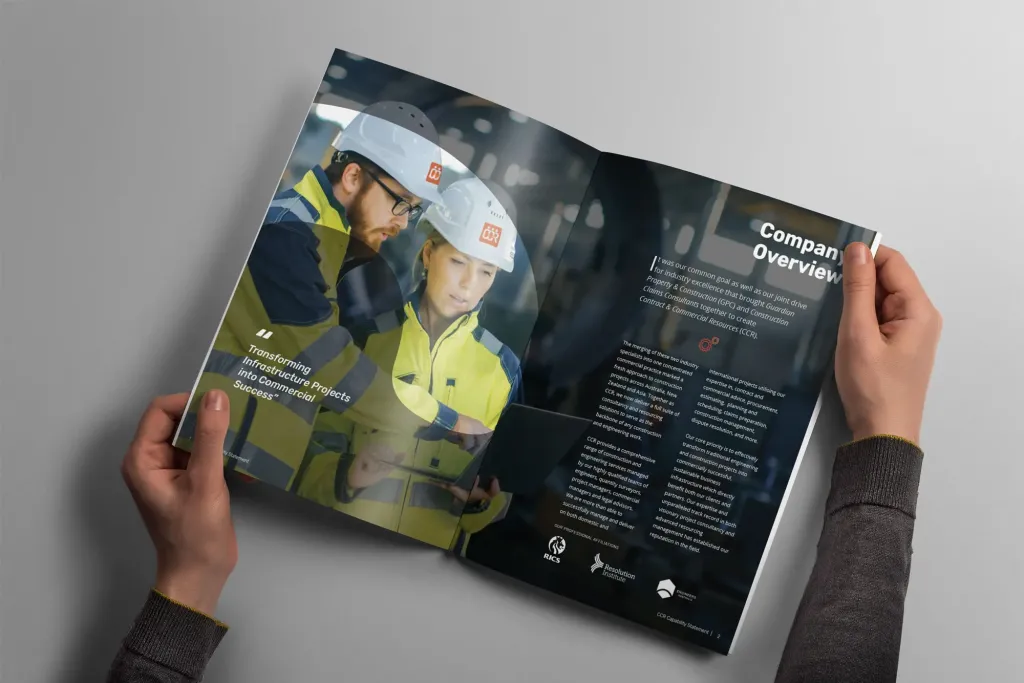
A capability statement is how you present those credentials in one document the buyer can assess quickly.
A capability statement showcases your business’s core competencies, past performance, key differentiators, and compliance credentials.
Think of it as your business’s professional resume, designed specifically for winning tenders.
Most tender responses require you to provide:
- Company overview and history
- Relevant experience and past projects
- Key personnel and their qualifications
- Certifications and insurances
- Financial capacity and business structure
- Quality, safety, and environmental management systems
- References from previous clients
A well-prepared capability statement compiles all this information in a professional, branded format that you can adapt for different tender opportunities.
Rather than scrambling to gather information and write descriptions for every tender, you start with a solid foundation that positions your business competitively.
Beyond tender responses, capability statements are valuable for:
- Pre-qualification processes and supplier registrations
- Panel applications where you’re seeking to join an approved supplier list
- Direct marketing to potential clients who may invite you to tender
- Business development meetings and networking events
How do you get started with tendering?
If you are new to tendering, work through these seven steps before you bid.
1. Prepare your business foundations
Before pursuing tenders, ensure your business has the necessary credentials:
- Appropriate insurances – Public liability, professional indemnity, workers compensation
- Business registrations – ABN, ACN, GST registration, industry licences
- Quality systems – Documented policies and procedures, quality management systems
- Financial capacity – Ability to demonstrate financial viability and carry contract risk
- Safety credentials – Work Health and Safety systems, safety policies
2. Develop your capability statement
Create a professional capability statement that clearly communicates your business’s value proposition. This document should be:
- Professionally designed with strong visual appeal
- Clearly structured with easy-to-navigate sections
- Focused on outcomes and results, not just activities
- Supported by evidence, examples, and data
- Regularly updated as your business grows
If you need help developing your capability statement, consider using professional templates or engaging a specialist service to ensure your document meets industry standards.
3. Register on tender portals
Create accounts on relevant government tender portals and set up email notifications for opportunities matching your business capabilities. Take time to understand each platform’s features and search functions.
4. Start small and build experience
Don’t immediately pursue multi-million dollar contracts. Start with smaller tenders where you can learn the process and build your track record. Even unsuccessful tenders are valuable learning experiences.
5. Research past awards
Research your buyer by reviewing previously awarded contracts to understand what type of companies won similar tenders in the past and what the contracting agency looks for. This competitive intelligence helps you understand what success looks like.
6. Build your references
Strong referees who can attest to your performance are crucial. Find referees who know your business and can attest to your work, giving them clear information about the tender request so they know what points to emphasise.
7. Consider professional support
Many businesses benefit from professional tender support, whether that’s:
- Tender writing services for complex bids
- Bid management consulting for high-value opportunities
- Training to build internal tender capabilities
- Template development for consistent, quality submissions

What help is available for preparing a tender?
Most businesses buy in help for at least part of the tendering process. The right type of support depends on the size and complexity of the opportunity, your internal resources and how much tender experience your team already has.
Tender writing services
Tender writing services suit complex or high-value bids where you need support planning, drafting and reviewing the response.
A tender writer can help structure responses around the evaluation criteria, strengthen supporting evidence and improve clarity and consistency across the submission.
Bid management consulting
Bid management consulting suits high-value opportunities or businesses managing several contributors, documents and deadlines at once.
Support may include response planning, compliance tracking, stakeholder coordination, review stages and submission readiness.
Tender training
Training helps businesses build internal tender capabilities rather than relying on external support for every submission.
It can be useful for teams that tender regularly and want a more consistent approach to opportunity assessment, response planning, writing and review.
Template development
Template development helps businesses create a consistent structure for recurring tender responses.
Reusable templates can reduce preparation time and give teams a clearer starting point for common content such as company information, methodologies, project experience and supporting evidence.

What are the next steps for tendering?
Understanding what tendering is and how it works is the first step.
The next stages involve building your tendering capability, developing strong submission materials like professional capability statements, and systematically pursuing opportunities aligned with your business strategy.
Tendering improves with practice. Your first submissions may not win, but each one shows you more about what buyers want and how to evidence your value.
Whatever the scale of work you are targeting, tendering gives you a structured route to it. Start with solid foundations: get your business credentials in order, prepare materials that position you competitively, and approach tendering strategically rather than opportunistically.
Ready to strengthen your tender capabilities? A professional capability statement is essential for successfully responding to tenders. Explore our capability statement services to discover how we help Australian businesses win more government contracts and tenders.

Can a sole trader submit a tender?
Yes, where the tender allows it and the sole trader can meet the stated eligibility, capability, insurance and compliance requirements. The tender documents determine who is eligible to respond.
Do you need to be prequalified before submitting a tender?
Not always. Open tenders may allow any supplier that meets the stated eligibility criteria to respond. Selective tenders may require suppliers to be prequalified, shortlisted or invited before they can submit.
Can a late tender be accepted?
Usually not. Tenders received after the stated closing date and time are generally treated as late. Exceptions may apply where the delay was caused by the agency or by a technical issue with the tendering platform.
Does it cost anything to register on a tender portal?
Registration requirements vary between tender portals. Check the relevant portal before registering, including any account, subscription or access requirements.
Do you need insurance before submitting a tender?
It depends on the tender. Buyers may specify particular insurance types or minimum cover requirements as part of the eligibility or contract conditions. Check the tender documents before submitting and make sure you can meet any required cover if the contract is awarded.