




Tender value is the maximum dollar amount an Australian government agency estimates it will spend on a contract across its entire life, including every option, extension and renewal it might exercise.
In Australia, this figure determines whether contracts get publicly advertised, what compliance you’ll need, and how competitive the bidding process will be.
This guide shows how agencies build that figure, how it differs from contract value and tender price, and which value band suits your business right now.
Key takeaways
- Below threshold: Agencies can use direct purchasing — opportunities often aren’t advertised
- Above threshold: Mandatory open tender with public advertising on AusTender or state portals
- Your capability statement should scale with the contract values you’re targeting
What does tender value mean in an Australian government tender?
Tender value is the buying agency’s own estimate of the maximum it will spend over the full life of a contract, set and published before any bids are received.
It is not just the upfront price tag. It covers everything the agency expects to spend, including options, extensions, renewals and any other mechanism it might exercise during the contract period.
Think of it as the maximum potential spend, not the minimum guaranteed amount.
How is tender value calculated?
The Commonwealth Procurement Rules set out how agencies must calculate estimated value. Under paragraph 9.2, the expected value must be estimated before the procurement method is chosen and must reflect the maximum value of the proposed contract, including options, extensions, renewals or other mechanisms that may be exercised over its life.
Agencies must include:
- The value of goods and services being procured
- All forms of remuneration, including premiums, fees, commissions, interest and allowances
- Any options, extension periods or renewals built into the contract, whether or not the agency ultimately exercises them
- Taxes and charges
- Ongoing costs across the whole contract term, including transition-in, implementation and any contingency allowance built into the estimate
Worked example
Suppose a contract has a three-year base term worth $40,000 per year, plus two optional one-year extensions at the same annual value.
- Three-year base term: $120,000
- First one-year option: $40,000
- Second one-year option: $40,000
- Maximum estimated tender value: $200,000
The tender value is therefore $200,000, even though the initial three-year term is worth $120,000 and the agency may never exercise either extension.
When a procurement runs in multiple parts, with contracts awarded at the same time or over a period, agencies must add up all parts to determine the total value. A procurement must not be divided into smaller parts solely to avoid a relevant threshold. If you believe a Commonwealth procurement has been structured that way, concerns can be raised through the procuring agency’s procurement complaints process.
Where the maximum value genuinely cannot be estimated, the procurement must be treated as though it sits above the relevant threshold.
Does tender value include GST?
For Commonwealth procurements, yes. The Commonwealth Procurement Rules state that where they refer to thresholds and values, those amounts are inclusive of GST.
State and territory procurement rules do not all use the same GST convention, so the relevant tender documents or jurisdictional procurement rules should be checked rather than assuming the Commonwealth treatment applies everywhere.
What is the difference between tender value, contract value and tender price?
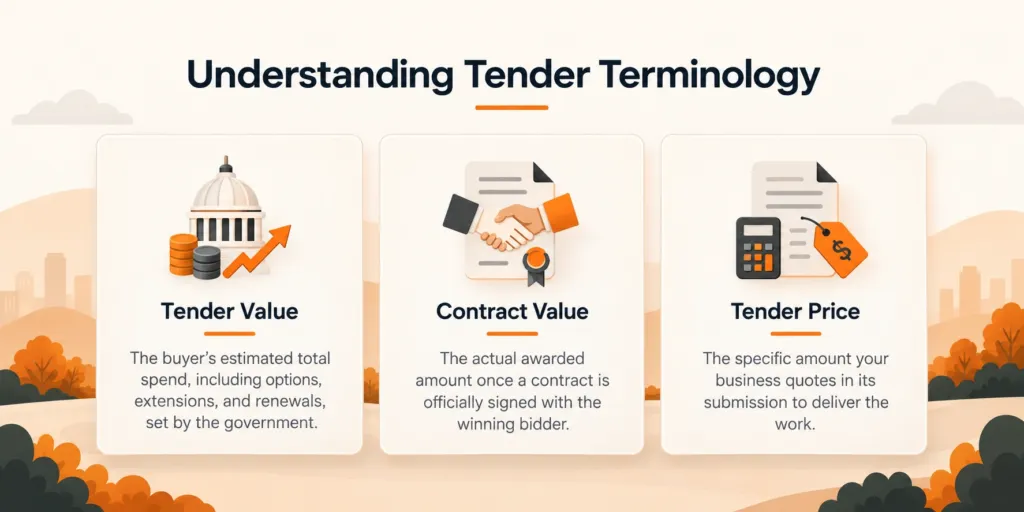
Tender value, contract value and tender price are three separate figures that exist at different points in a procurement, and confusing them can mean pricing a bid against the wrong number.
| Tender value | Contract value | Tender price | |
|---|---|---|---|
| What is it? | The agency’s estimated maximum spend | The actual awarded amount once a contract is signed | The amount you quote to deliver the work |
| Who sets it? | The buying agency | The agency and successful supplier through the awarded contract | You, as the tenderer |
| When does it exist? | Before the tender is advertised | After the contract is awarded | When you prepare your submission |
| Can it change? | It is not changed by the prices bidders submit | It reflects the final awarded contract | It may change while you develop your bid, but becomes your submitted offer |
| What do you use it for? | To assess the opportunity, applicable procurement rules and whether it suits your business | To understand what similar work has actually been awarded for | To price your own proposed delivery |
When a procurement officer estimates tender value, they’re figuring out which rules apply to the purchase.
Your job as a tenderer is to read that figure for two decisions: whether the opportunity is winnable for a business your size, and whether it is worth what the bid will cost you to prepare.
What do tender amount and tendered amount mean?
Tender amount, tendered amount and amount tendered generally refer to the price a supplier submits in response to a tender. In this context, they mean the same thing as the tender price, not the agency’s estimated tender value or the final contract value.
Why Tender Value Matters for Australian Businesses
Why does tender value matter for Australian businesses?
Tender value affects your business in four critical ways.
1. It determines how contracts get awarded
Above certain thresholds, agencies must run open competitive processes.
Below those thresholds, they have the flexibility to purchase directly or seek limited quotes.
This means many lower-value opportunities never appear on a tender portal at all. They are handled through existing relationships, standing panels and direct approaches.
2. It sets your compliance requirements
A $50,000 contract usually needs your ABN, current public liability and workers compensation certificates, and two or three relevant referees.
A $5 million contract requires detailed methodology, financial capacity evidence, insurance certificates and possibly security clearances.
3. It affects competition intensity
Competition does not rise in a straight line with value. Mid-value contracts usually attract the widest field because they are large enough to be worth bidding for and small enough that more suppliers can qualify.
But don’t assume smaller is always easier.
Very large contracts often draw fewer bidders because prequalification, financial capacity and insurance requirements thin the field before anyone writes a word.
4. It guides your targeting strategy
A sole trader will not clear the financial capacity and comparable-project tests on a $10 million infrastructure job, no matter how strong the price is.
An established contractor loses money on $20,000 quotes when the hours spent preparing the response exceed the margin the job can return.
Your target band is the range where you can evidence comparable delivery and still cover the cost of bidding. The value bands set out later on this page show where that usually falls.
How do thresholds change what a tender value means?
Procurement thresholds determine when agencies must follow additional procurement rules and, in most cases, use an open competitive process.
Thresholds differ between federal, state and local government. This section covers the Commonwealth figures and what crossing them means for a tender value. For the full state, territory and council figures, see our guide to Australian tender thresholds.
What are the current Commonwealth procurement thresholds?
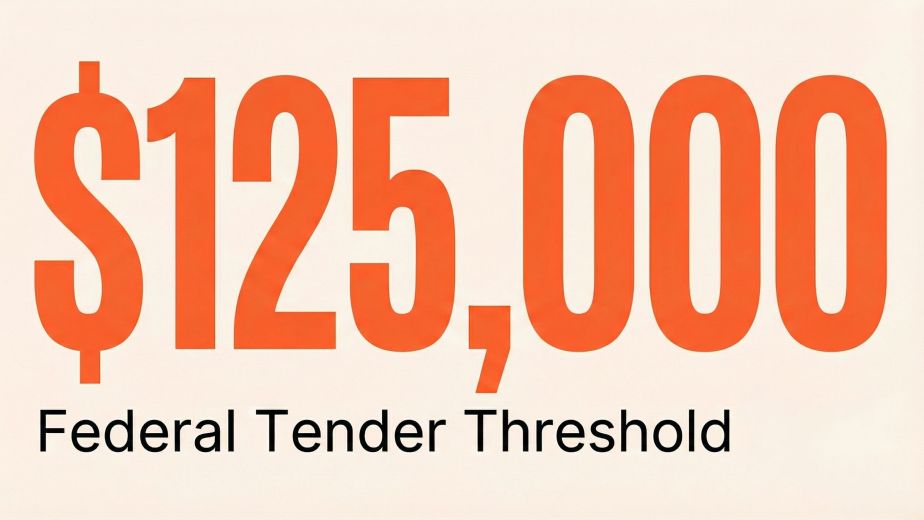
From 17 November 2025, the non-construction procurement threshold for non-corporate Commonwealth entities increased from $80,000 to $125,000. The thresholds for prescribed corporate Commonwealth entities and construction services did not change.
All Commonwealth Procurement Rules thresholds and values are inclusive of GST.
| Entity type | Goods and services | Construction services |
|---|---|---|
| Non-corporate Commonwealth entities | $125,000 | $7.5 million |
| Prescribed corporate Commonwealth entities | $400,000 | $7.5 million |
These are the thresholds set out in paragraph 9.7 of the current Commonwealth Procurement Rules.
What do these thresholds mean in practice?
When the expected value of a procurement is at or above the relevant threshold, Division 2 of the Commonwealth Procurement Rules applies unless an exemption applies. Open tender is the standard approach, while limited tender is permitted only in specified circumstances.
For a non-corporate Commonwealth entity purchasing goods or services, that means the additional rules apply once the expected value reaches $125,000.
Below $125,000, agencies have more flexibility in how they procure. They might seek quotes from a small number of suppliers, use an existing panel or approach suppliers directly.
There are also SME-specific exemptions. Under Exemption 17, an entity can directly engage a small or medium enterprise for a procurement valued up to $500,000 including GST, provided value for money can be demonstrated and any applicable Indigenous Procurement Policy requirements are met.
For an SME, that exemption is one reason a contract in your range may never appear as an open opportunity on AusTender, which makes being known to relevant procurement teams as important as watching the portal.
Every state and territory sets its own procurement thresholds, while council requirements vary by jurisdiction. Rather than duplicating those figures here, refer to our guide to Australian tender thresholds.
How does tender value determine the procurement method?
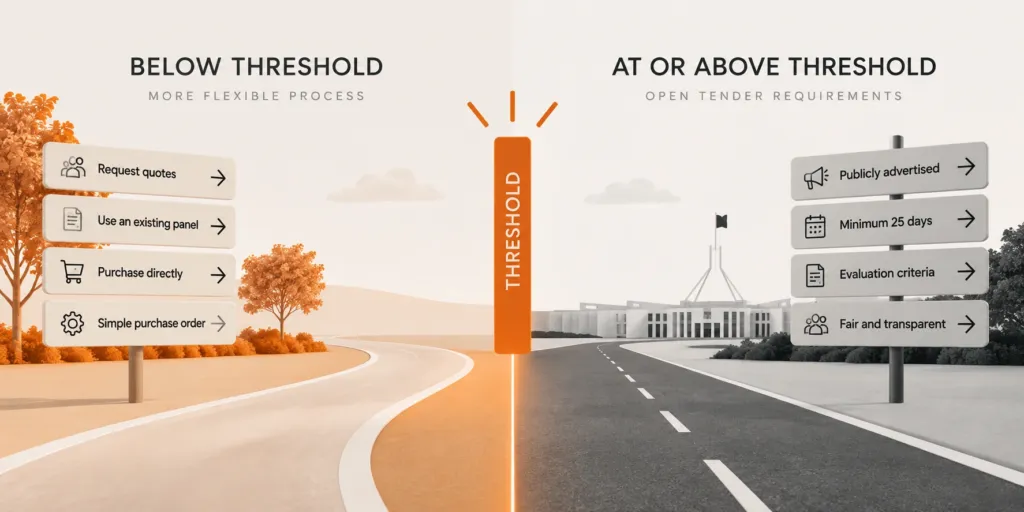
Crossing a threshold changes the method the agency must use, whether the opportunity is advertised at all, and how much evidence you have to supply with your bid.
Below threshold: What happens
When a procurement falls below the relevant threshold, agencies have flexibility.
They might:
- Request quotes from three suppliers
- Purchase directly from an existing panel
- Approach a known supplier without competition
- Use a simple purchase order
The consequence for you is that these opportunities are often never advertised publicly.
If a tender portal is your only source of opportunities, you can miss below-threshold contracts in your category that are sourced directly.
This is where relationships do the work a portal cannot: attending industry events, meeting agency procurement teams and getting onto standing offer panels all open doors to contracts that never hit the public market.
At or above threshold: Open tender requirements
Once a procurement crosses the threshold, the rules tighten.
Once a federal procurement reaches the relevant threshold, the agency must:
- Publish an open approach to market, usually on AusTender
- Allow at least 25 days for suppliers to lodge submissions for an open tender, subject to the extensions and permitted shorter time limits set out in the Commonwealth Procurement Rules
- Disclose evaluation criteria in tender documentation
- Treat all tenderers fairly and without discrimination
- Report the awarded contract publicly as a contract notice on AusTender, the same record you can search when researching what similar work has been worth
State governments follow similar principles, though specific timeframes and requirements vary.
If a contract in your value range was never advertised, it may have been run as a limited tender, where the agency approaches chosen suppliers directly. Our guide to tender types sets out how each approach works.
Limited tender above threshold is only permitted in specific circumstances: emergencies, sole suppliers, failed previous tenders, or certain SME exemptions.specific circumstances: emergencies, sole suppliers, failed previous tenders, or certain SME exemptions.
How can you estimate a tender value when none is published?
Not every tender notice publishes an estimated value, though larger procurements usually do. An agency is not obliged to publish one before award.
On AusTender, check the Approach to Market details. Some agencies include budget ranges or estimated values in the description or attached documentation.
If no value is published, previous awarded contracts can help you build a reasonable estimate. Awarded contract data is the closest thing to a public price record for what government agencies have paid for comparable work.
AusTender contract notices can be searched by:
- Agency name
- Supplier name
- Category (UNSPSC codes)
- Value range
- Date range
This data helps you:
- Understand what agencies actually pay for services like yours
- Identify competitors winning similar work
- Spot patterns in procurement timing
- Benchmark your pricing against market rates
Before you respond, search contract notices for the same UNSPSC category with the same agency, then divide each awarded value by its contract term so you are comparing annual spend rather than headline figures.
For example, if a comparable contract was awarded for $600,000 over three years, that represents an annual contract value of about $200,000. Compare several similar awards rather than relying on a single contract, particularly where the scope or contract term differs.
That gives you a more defensible estimate when the current tender notice publishes no value at all.
State portals offer similar functionality, though the level of detail varies.
For a broader explanation of where to search for live opportunities, see our guide to finding government tenders.
Which tender values should you target?
The right target band depends less on ambition than on evidence: what you can prove you have delivered, and what you can afford to spend chasing the next contract. These bands are a starting position, not a rule.
New to government tendering (0–2 years experience)
Suggested starting band: $50,000 to $250,000. Adjust it upward if you already hold comparable private-sector referees.
Smaller contracts make sense at this stage because they rarely demand three years of comparable government past performance, which is the requirement most first-time bidders fail on.
Focus on:
- Open tenders that don’t require extensive past performance evidence
- Requests for Quotation (RFQs) which are simpler to respond to
- Local council opportunities where relationships develop faster
- Panel arrangements that get you in the door for future work
Your goal at this stage is not the biggest contract you can find, but a track record and a set of referees you can put in front of the next evaluation panel.
Deliver three or four smaller contracts well and you have what the next band actually asks for: named referees, measurable outcomes and a delivery record at a comparable scale.
Building your reputation (2–5 years experience)
Suggested band: $250,000 to $1 million. This is the range where past performance starts to outweigh price.
Now you’ve got runs on the board.
Start pursuing:
- Selective tender invitations based on your growing reputation
- Prequalification panels at state and federal level
- Multi-year contracts that provide revenue stability
- Subcontracting opportunities on larger projects
Do not abandon the smaller work that got you here. Keep it running as your base while you stretch into mid-value opportunities where you can already evidence comparable delivery.
Established supplier (5+ years experience)
Suggested band: $1 million and above. At this level, prequalification schemes and panel membership can determine who is invited to bid.
Once you can point to completed contracts at a comparable scale, audited financials and current prequalification, you are competing on the same terms as the incumbents.
Focus on:
- Selective and invited tenders reached through prequalification scheme or panel membership
- Two-stage procurement with early contractor involvement
- Strategic partnerships and joint ventures for very large projects
- Long-term panel positions with major agencies
Price carries less weight as value rises. At the top band, agencies can place greater emphasis on methodology, team capability, risk management and past performance alongside price.
And your capability statement needs to demonstrate you can handle the scale.
What does it cost to bid, and when is it worth it?
There is no reliable Australian benchmark for what a tender should cost a business to prepare. The cost depends on the complexity of the submission, the people involved, external support and the amount of evidence that needs to be developed.
Instead, calculate your own bid cost by adding:
- Internal staff hours spent reviewing, writing and managing the submission
- The cost of specialist, legal, design or tender-writing support
- Time spent gathering compliance documents, pricing and evidence
- Any other direct costs involved in preparing the response
Then compare that investment with the contract value, expected margin and your realistic probability of winning.
A simple break-even test is:
Probability of winning × expected contract contribution > cost of preparing the bid
The larger the gap in your favour, the easier it is to justify committing resources to the submission. If the bid only makes financial sense under an optimistic win assumption, it may be better to pass.
Should you bid? A short checklist

Before committing to an opportunity, check whether:
- You have comparable evidence: Can you show relevant projects, outcomes and referees at or near this scale?
- You meet the requirements: Can you satisfy the mandatory qualifications, insurance, financial capacity and prequalification criteria?
- You have delivery capacity: Can your team take on the contract without putting existing work at risk?
- The bid is commercially worthwhile: Does the likely return justify the time and cost required to prepare the response?
- The opportunity fits where you are heading: Will the contract strengthen your track record, relationships or position for future work?
If several of these answers are no, a larger tender value does not necessarily make the opportunity more attractive.
What does value for money mean in government tenders?
Achieving value for money is the core rule of the Commonwealth Procurement Rules. Government buyers are not required to choose the lowest price. They must consider the financial and non-financial costs and benefits of each submission.
This can include:
- Quality and fitness for purpose
- Relevant experience and performance history
- Flexibility, innovation and adaptability
- Environmental sustainability
- Whole-of-life costs
- The risks associated with the proposal
Whole-of-life cost can extend beyond the initial purchase price to operating, maintenance, licensing, transition and disposal costs.
For tenderers, that means a lower price does not automatically represent better value. Your submission needs to show why the proposed outcome, delivery approach and overall cost offer value over the life of the contract.
What are common mistakes when reading tender value?
Tender value is useful only if you interpret the figure correctly. Common mistakes include:
Treating the tender value as guaranteed spend
Tender value represents the agency’s maximum estimated spend, not the amount it guarantees to spend. Options, extensions and renewals may be included even if they are never exercised.
Confusing tender value with contract value or tender price
Tender value is the agency’s estimate before bids are received. Contract value is the amount ultimately awarded, while tender price is the amount you submit in your response.
Ignoring options and extension periods
Looking only at the initial contract term can make an opportunity appear smaller than it is. Check whether the published value includes optional extensions, renewals or additional contract periods.
Comparing headline contract values without checking the term
A $600,000 three-year contract and a $600,000 one-year contract represent very different levels of annual work. When researching previous awards, compare the contract term as well as the total value.
Assuming a smaller tender is automatically easier
Lower value does not necessarily mean a better opportunity. Consider the eligibility requirements, competition, likely margin and cost of preparing the submission before deciding whether to bid.
Assuming there is nothing to work with when no value is published
If an agency does not publish an estimated value, you can still research previous contract notices for similar work, matching the agency, UNSPSC category and contract term to build a more defensible estimate.
How should your capability statement scale with contract value?
Your capability statement should match the contract values you’re pursuing.
A capability statement built for a $50,000 contract will not survive a $5 million evaluation, and the reverse wastes everyone’s time. View examples at different contract scales to see how the evidence load changes.
For lower-value contracts (under $250,000):
- Keep it concise: 2 to 4 pages
- Focus on relevant experience and qualifications
- Include essential insurance and compliance certifications
- Highlight responsiveness and local presence
For mid-value contracts ($250,000 to $1 million):
- Expand to 4 to 8 pages
- Add detailed case studies with measurable outcomes
- Demonstrate financial capacity
- Include organisational structure and key personnel
- Show quality management systems
For high-value contracts (over $1 million):
- Comprehensive document: 8+ pages
- Multiple detailed case studies at comparable scale
- Financial statements or capacity evidence
- Risk management frameworks
- Sustainability and social procurement credentials
- References from similar-scale projects
Evidence requirements scale with contract value because a panel evaluating a $10 million bid has to be able to point to the reason they believed you could deliver at that level.
How should tender value guide your bid decisions?
Read a tender value properly and you learn three things at once: how the agency has to buy, how much evidence you will have to produce, and whether the contract is worth your bid budget.
Before you commit to a bid, check the value against your target band, your evidence and your bid budget.
The businesses that win consistently don’t chase everything. They match contract sizes to their capability, build track records progressively, and scale their capability statements to meet evidence requirements at each level.
Start where you can win, then build from there.
If you are moving up a value band and your capability statement has not moved with you, send us the contract values you are targeting and we will tell you what the document needs to carry. We reply within 24 hours.
What is the difference between tender value and contract value?
Tender value is the estimated maximum spend set by the agency before procurement begins.
Contract value is the actual awarded amount once a supplier is selected.
Tender value determines which rules apply; contract value reflects the negotiated outcome.
What is the tender threshold in Australia?
The federal threshold for non-corporate Commonwealth entities buying goods and services is $125,000 including GST, effective from 17 November 2025.
State, territory and council thresholds differ. See our guide to Australian tender thresholds for the relevant figures.
Why is tender value important?
Tender value is the figure that helps inform your bid or no-bid decision: it tells you which procurement rules the agency must follow, how much evidence the submission may demand, and whether the contract can justify the cost of preparing your bid.
Understanding thresholds helps you target realistic opportunities and prepare appropriate responses.
What happens below the procurement threshold?
Agencies have flexibility to purchase directly, seek limited quotes, or use existing panels. These opportunities often aren’t publicly advertised, which is why relationship-building and panel membership matter.
How do I find the value of a tender?
Check the tender documentation for estimated values or budget ranges. For research purposes, search awarded contract notices on AusTender or state portals. Our guide to finding government tenders covers which portals to monitor.
Does the lowest price always win a tender?
No.
Government procurement focuses on value for money, which includes quality, capability, risk and whole-of-life cost rather than lowest price alone.
Higher-value tenders especially weight non-price criteria heavily, which is where evidence of comparable delivery matters most. See what government buyers look for in a capability statement.
Does tender value include GST?
For Commonwealth procurements, the thresholds and values stated in the Commonwealth Procurement Rules are inclusive of GST.
For state, territory and local government opportunities, check the relevant procurement rules or tender documentation, as the treatment may differ between jurisdictions.
Is the published tender value guaranteed?
No. Tender value is an estimate of the maximum potential value of the procurement, not a guarantee that the agency will spend that amount.
It can include optional extensions, renewals and other contract mechanisms that may never be exercised, so the final awarded or actual contract value may be lower.
Need help with your capability statement?
Most capability statements still look like they were made in 2003.
Yours doesn’t have to.
Whether you need us to write the whole thing or just make it look professional, we’ll sort it.
No corporate waffle, just a document that stands up in an evaluation. Tell us the contract values you are chasing and we will come back to you within 24 hours.