

What is tender search, and what is TenderSearch?
Tender search is the process of finding relevant government and private-sector tender opportunities through procurement portals, tender notification services and supplier platforms. TenderSearch, by comparison, is a commercial tender notification provider in Australia.
Key takeaway:
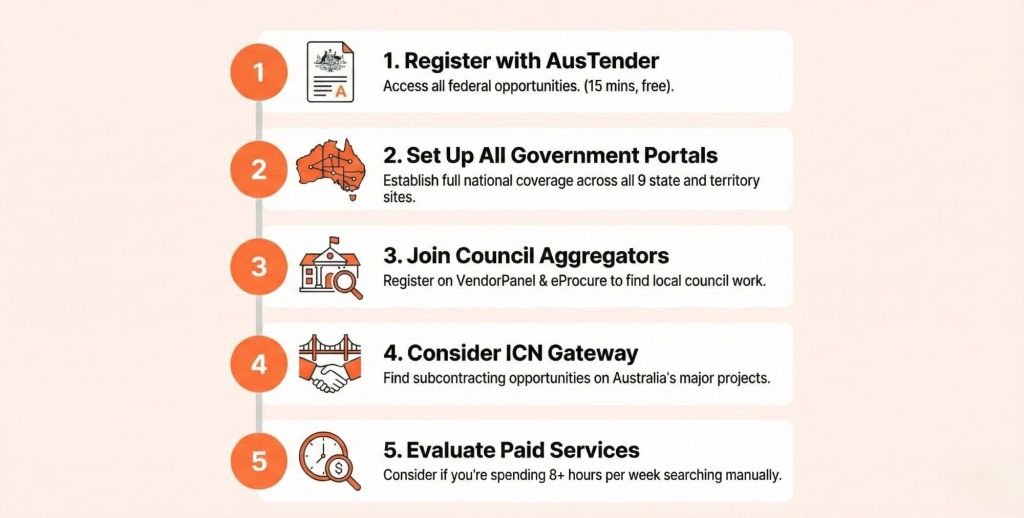
To find tenders in Australia, start with AusTender for federal opportunities (free) and your state’s eTendering portal.
- Set up all nine government portals for full national coverage.
- Consider paid services if you spend 8+ hours weekly on manual searches.
- Check the ICN Gateway for subcontracting opportunities on major projects.
- Many businesses rely only on free portals and miss a significant amount of available work, especially in the private sector.
This guide covers all nine free government portals, the paid services that aggregate opportunities, and private-sector channels that do not appear on government portals.
Where can you search Australian tenders for free?
Every federal, state, and territory government provides a free tender portal. This covers the majority of public procurement; however, each system operates independently, so visibility depends on registering across all platforms.
AusTender: the federal government’s central portal
AusTender (tenders.gov.au) is the Commonwealth’s central procurement portal and is completely free to access. Registration takes around 15 minutes and requires your ABN and contact details.
Key features include:
- Access to tender documents and evaluation criteria
- Awarded contract data for competitor and pricing insights
- Annual and Forward Procurement Plans
- Customisable email alerts (category, keyword, agency)
Forward procurement plans and the 12–18 month lead time
Annual and Forward Procurement Plans are particularly useful for identifying potential opportunities 12–18 months ahead, giving businesses more time to prepare before procurement begins.
How to see who won past tenders
AusTender also provides awarded contract data that can be used for competitor and pricing insights when researching similar opportunities.
State and Territory Tender Portals (Complete List)
Each state and territory runs its own procurement system. Each portal works slightly differently, but all of them are free.
Here’s your complete reference:
| State/Territory | Portal Name | URL | Free Alerts |
| Federal | AusTender | tenders.gov.au | Yes |
| NSW | buy.nsw / eTendering | tenders.nsw.gov.au | Yes |
| VIC | Buying for Victoria | tenders.vic.gov.au | Yes |
| QLD | QTenders | hpw.qld.gov.au/qtenders | Yes |
| WA | Tenders WA | tenders.wa.gov.au | Yes |
| SA | SA Tenders & Contracts | tenders.sa.gov.au | Yes |
| TAS | Tasmanian Government | tenders.tas.gov.au | Yes |
| NT | Quotations & Tenders | nt.gov.au/tenders | Yes |
| ACT | Tenders ACT | tenders.act.gov.au | Yes |
Register with all nine portals in one sitting. Yes, it’ll take a couple of hours. But you’ll only do it once, and you’ll have complete coverage of Australian government tender opportunities.
Where can you find local council tenders?
Local councils play a significant role in public procurement. Their spend covers civil works, facilities management, consulting, IT, waste, landscaping, and more.
Because there is no single national portal, council tenders are spread across multiple systems.
Useful platforms include:
- VendorPanel and eProcure: These platforms host tenders for hundreds of councils across multiple states. Free to register as a supplier.
- WALGA Preferred Supplier Program: Covers Western Australian local governments. Once approved, you’re on a panel that councils can draw from directly.
- LG Tenderbox: Aggregates Queensland council opportunities in one place.
- Direct search: Google “[Council name] tenders” to find individual portals. Bookmark the ones in your service area.
Council tender response windows can be as short as two to three weeks, depending on the jurisdiction, so check each opportunity’s closing date carefully. If you’re serious about local government work, check your priority councils at least twice weekly.
How can you find private-sector tenders in Australia?
Private-sector tenders are harder to track because there is no central portal, and most do not appear on government tender websites.
Useful channels include:
- Australian Tenders: Includes private-sector listings alongside government opportunities.
- TenderLink: Used by large corporate buyers to publish opportunities.
- Industry publications: The Australian Financial Review, The West Australian and sector-specific trade publications may publish tender notices.
- Corporate supplier portals: Major organisations such as BHP, Rio Tinto, Fortescue, Woolworths and Coles operate their own supplier registration or procurement channels.
Winning private-sector work differs from winning government work. Buyers may place greater emphasis on relationships, track record and innovation alongside formal requirements, so it helps to register on relevant supplier portals and build relationships before an opportunity is advertised.
For a more detailed breakdown of private-sector opportunities and where to find them, see our guide to private tenders in Australia.
Are paid tender notification services worth it?
The value of a paid tender notification service depends on your time, the types of contracts you are targeting and whether free portals provide enough coverage for your business.
When do paid services make sense?
Free portals cover public procurement well, but paid services can address three specific limitations:
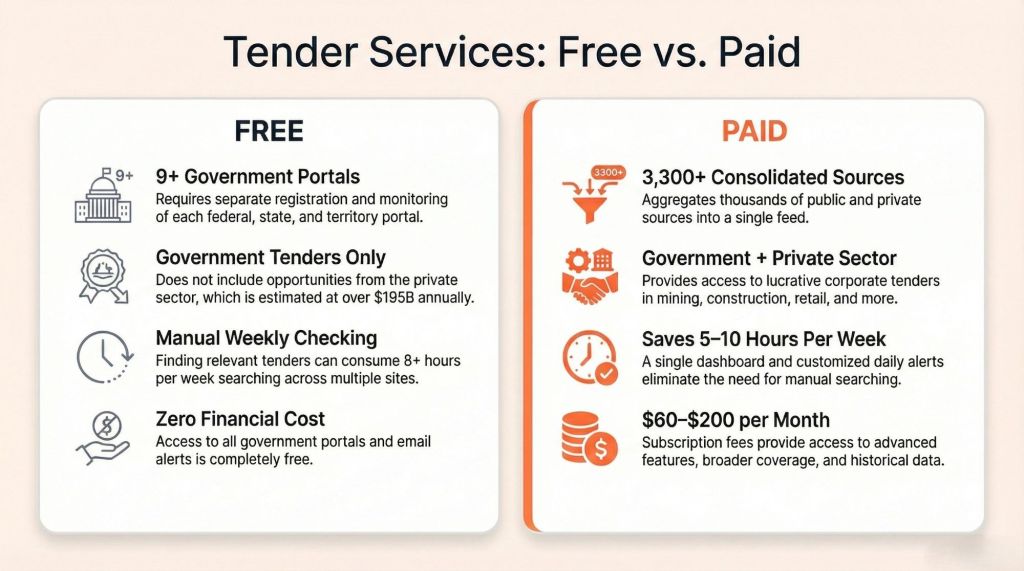
- Time savings: Instead of checking government portals, council websites and other tender sources individually, opportunities are brought together in one place. For example, illion TenderLink currently states that it monitors 3,300+ sources daily across Australia and New Zealand.
- Private-sector coverage: Government portals don’t list private tenders. If you’re targeting corporate work in areas such as mining, retail, construction or subcontracting, you won’t find those opportunities on AusTender.
- Historical data: Some paid services provide searchable award information as well as current opportunities. TenderLink, for example, currently provides access to 138,000+ award records, which can help identify contract values, recurring suppliers and potential future opportunities.
Historical award data shows what comparable contracts sold for and which suppliers keep winning them.
The arithmetic is simple: if one $50,000 contract covers three to five years of subscription fees, the service has paid for itself.
Do paid aggregators really hold exclusive opportunities?
Some do, although the extent of that exclusive access varies by provider.
TenderSearch states that its members receive private opportunities exclusive to eProcure, its own procurement platform. TenderLink similarly operates its own network of buyer portals and currently reports more than 600 Buyer Partners, alongside opportunities sourced from other public channels.
This means a paid service may provide access to opportunities that are not listed on government portals. However, “exclusive” does not mean every tender on an aggregator is unavailable elsewhere, so businesses should compare the provider’s actual buyer network and sector coverage before subscribing.
What do tender notification services cost in Australia?
Current pricing, last checked September 2026:
| Service | Coverage | Monthly | Annual | Alerts |
|---|---|---|---|---|
| Australian Tenders | AU + NZ | $67–$145 | 1 month free | As released |
| TenderLink | AU + NZ | From $95 + GST | From $1,140 + GST | Daily |
| TenderSearch | AU + NZ | $67–$191 | 10% off yearly | Real-time |
| Tenders.Net | AU + NZ | Not public | Not public | Daily |
| AusTender Alerts | Federal only | Free | Free | Customisable |
The sensible sequence is to start with the free portals. Track how many hours you spend searching each week and how many relevant opportunities you find. If you’re missing tenders or spending 8+ hours weekly on searches, trial a paid service where available.
How do category codes affect your tender search?
Tender portals do not rely on keywords alone. Many also classify opportunities using category systems such as UNSPSC codes or their own procurement categories.
If your alerts only use a small set of keywords, you may miss relevant tenders that use different terminology. For example, a buyer may classify an opportunity under a broader service category rather than use the exact wording your business normally searches for.
To improve coverage:
- select the most relevant categories or UNSPSC codes for your services
- combine category filters with several related keywords
- review broader categories where your services may sit
- update your saved searches as you learn how buyers describe the work
Using both category codes and keywords gives you a broader search than relying on either method alone.
How should you set up and manage tender alerts?
Free tender alerts are available in Australia. Every government portal offers email alerts, including AusTender for federal opportunities and all eight state and territory eTendering sites.
You can configure alerts by keyword, industry category or agency. The limitation is that you must register with each portal separately, and none of them covers private-sector tenders.
Once your alerts are running, keep track of the opportunities you find. Saved searches, portal watchlists and a simple tender pipeline can help you record:
- the opportunity and buyer
- the closing date
- whether you plan to bid
- documents or information still required
- the outcome once the tender is awarded
This makes it easier to manage multiple opportunities without losing track of deadlines or repeatedly reviewing the same tender.
What should you do if you find a tender after it has closed?
If an opportunity has already closed, check whether the portal provides an award notice or contract result, and review the buyer’s Forward Procurement Plan for similar upcoming work.
You can also update your alerts and saved searches so you are notified earlier when comparable opportunities are published in future.
Which industry-specific tender platforms should you use?
Some sectors have dedicated platforms that carry opportunities the general portals never list.
ICN Gateway: infrastructure and major projects
The Industry Capability Network (ICN) Gateway is where Australia’s biggest infrastructure projects list subcontracting opportunities.
As of September 2026, current project listings include the SSN-AUKUS Build Program, VicGrid and Northern Water.
Registration is free for Australian and New Zealand businesses. Once you’re in, you can:
- Browse upcoming major project pipelines
- Submit Expressions of Interest (EOIs) directly to project teams
- Get matched with prime contractors seeking local suppliers
If you’re in construction, engineering, manufacturing, or professional services for major projects, ICN Gateway should be on your radar.
BuyICT: digital and IT services
BuyICT and the Digital Marketplace list government IT opportunities across federal, state and local government.
The Digital Marketplace operates on a panel arrangement. Once you’re approved, agencies can approach you directly for quotes under certain thresholds. It’s a way to win work without going through full tender processes every time.
Construction and trade tenders
Construction businesses have several sector-specific options:
- QBuild eTender: Queensland government construction projects
- Buying for Victoria (construction category): Victorian government building and infrastructure
- Defence construction: Listed on AusTender, often requiring specific security clearances
Defence work, in particular, is worth pursuing if you can meet the compliance requirements. These compliance barriers can reduce the number of eligible bidders.
What do you need before you can bid?
Finding tenders in Australia comes down to three things: knowing where to look, understanding the rules that favour smaller suppliers, and building a system that catches opportunities before the deadline passes.
Start with AusTender registration. It takes around 15 minutes, is free, and connects you with federal government procurement opportunities. Then work through the state portals.
If you’re spending more than 8 hours weekly hunting for opportunities, trial a paid aggregation service.
The businesses that win government work aren’t necessarily the biggest. They’re the ones who show up prepared, meet compliance requirements, and respond before deadlines.
The next step is making sure you can respond before the deadline. With your portals registered and your documents ready, you can respond to the next relevant opportunity that appears.
Is AusTender free to use?
Yes, AusTender is completely free. Registration requires an ABN, and you can set up email alerts for matched opportunities at no cost.
Federal contracts valued at $10,000 or more are reported as contract notices by non-corporate Commonwealth entities. This is a contract-reporting threshold, not a rule that every tender above $10,000 must be openly advertised. Open tenders involve publishing an open approach to market.
The platform also provides access to awarded contract data and Forward Procurement Plans, also free.
How do I find local council tenders?
Search “[Council name] tenders” to find the direct portal. The easiest method is registering with aggregator platforms like VendorPanel or eProcure, which host tenders for hundreds of councils.
In Queensland, LG Tenderbox aggregates council opportunities. In WA, WALGA’s Preferred Supplier Program provides access to local government contracts across the state.
What documents do I need to tender?
Essential documents can include:
- ABN registration
- certificates of currency, such as public liability and professional indemnity
- a capability statement
- relevant certifications, including ISO certification where required
- WHS management systems documentation, including a health and safety policy
- financial statements where a financial viability assessment is required
Financial information requirements depend on the scale and risk of the procurement rather than a fixed contract-value threshold.
Keep these updated and ready. Tender deadlines don’t wait.
Can I tender for government contracts as a sole trader?
Absolutely. The Australian Government encourages SME participation, which can include sole traders that meet the relevant requirements.
In 2023–24, SMEs overall received 52.3% of Commonwealth contracts by volume. This figure applies to SMEs, not sole traders specifically.
The key is demonstrating capability, having appropriate insurance coverage, and meeting compliance requirements for your industry.
Can small businesses win government tenders?
Yes, and there are specific procurement policies designed to support SME participation.
The current Commonwealth Procurement Rules set targets for non-corporate Commonwealth entities to procure:
- at least 25% of contracts by value from SMEs for contracts valued up to $1 billion
- 40% of contracts by value from SMEs for contracts valued up to $20 million
SMEs can also be directly engaged for procurements valued up to $500,000 including GST under the relevant Commonwealth Procurement Rules exemption, provided the applicable conditions are met.
For non-panel procurements below the $125,000 Commonwealth procurement threshold, non-corporate Commonwealth entities must only invite Australian businesses to tender.
How much do tender notification services cost?
Pricing varies depending on the provider, geographic coverage and plan. Australian Tenders currently starts at $67 per month, TenderLink at $95 + GST per month, and TenderSearch at $67 + GST per month.
Most services use tiered pricing based on features and coverage. Trial or sample access varies by provider, so check the current offer before subscribing.
What is the best tender website in Australia?
For government tenders, AusTender is the essential free starting point for federal opportunities.
For broader coverage across state, local and private-sector opportunities, paid services such as Australian Tenders or TenderLink can bring multiple sources together.
The “best” option depends on your sector, budget and whether you need private-sector tender listings.
Are there free tender alerts in Australia?
Yes. Every government portal offers free email alerts, including AusTender and the eight state and territory eTendering sites.
You can configure alerts by keyword, industry category or agency. The limitation is that you must register with each portal separately, and they do not cover private-sector tenders.