




A tender writing consultant in Australia provides bid strategy, tender response writing, evidence coordination, compliance review and submission support for RFT, RFP, RFQ, EOI and panel application documents. The service helps businesses interpret procurement requirements, prepare evaluator-focused answers and organise supporting evidence for government or private-sector assessment.
This guide explains what a tender writing consultant does, how the role differs from a tender writer, when to engage one, how tender requirements are analysed, what information the business needs to provide and what to consider when choosing a consultant.
What Is A Tender Writing Consultant?
A tender writing consultant is a bid support specialist who plans, drafts, reviews and structures tender responses against buyer requirements and evaluation criteria. The consultant prepares written submissions for Australian government procurement, private tenders and supplier panel opportunities.
- Bid strategy: maps buyer needs, win themes, scope risks and evidence gaps.
- Tender writing: drafts response answers, methodology content, capability statements and executive summaries.
- Compliance review: checks mandatory criteria, response schedules, attachments and page limits.
- Submission support: prepares final files for lodgement and internal approval.
Tender consulting differs from general copywriting because procurement documents assess compliance, capability, risk, price and delivery methodology. A tender response needs direct answers and supporting evidence, rather than broad sales language.ance, capability, risk, price and delivery methodology. A tender response needs direct answers and proof, not broad sales language.
What Does A Tender Writing Consultant Do?
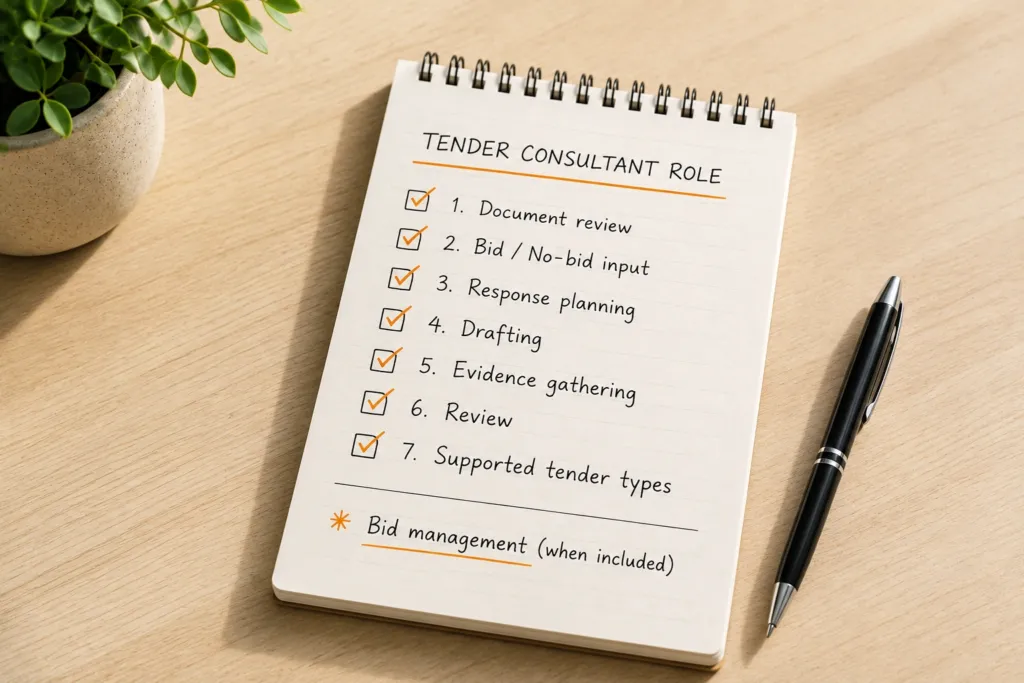
A tender writing consultant completes document review, bid planning, response drafting, evidence coordination, compliance checking and submission preparation. The role turns business capability into a structured bid that matches the buyer’s procurement framework.
- Document review: the consultant reads the Request for Tender (RFT), Request for Proposal (RFP), Request for Quotation (RFQ), Expression of Interest (EOI) or panel application.
- Bid/no-bid input: the consultant assesses scope fit, mandatory requirements, internal capacity, evidence gaps and likely competitiveness.
- Response planning: the consultant maps each criterion to an answer structure, evidence source and business owner.
- Drafting: the consultant prepares response text for methodology, capability, risk, safety, quality, experience and value-for-money sections.
- Evidence gathering: the consultant requests case studies, references, certifications, policies, team profiles, project data and pricing assumptions.
- Review: the consultant checks clarity, compliance, evaluator usability, formatting and response completeness.
- Supported tender types: the consultant supports government tenders, private sector bids, RFTs, RFPs, RFQs, EOIs and supplier panel applications.
Bid management sits inside the consultant role when the engagement includes stakeholder coordination, deadline tracking and final submission control.
What Is The Difference Between A Tender Writer And A Tender Writing Consultant?
A tender writer usually provides drafting and editing support, while a tender writing consultant usually provides strategy, compliance advice, bid management and response review as well as writing. Many Australian providers use both titles, so the actual process and deliverables matter more than the label.
| Attribute | Tender writer | Tender writing consultant |
| Core scope | Drafts and edits tender response content | Plans, drafts, reviews and manages bid response content |
| Strategy | Uses the supplied approach | Shapes win themes, buyer fit and response positioning |
| Compliance | Checks wording against instructions when included | Maps mandatory criteria, schedules, attachments and evaluator requirements |
| Stakeholder coordination | Requests missing information for drafting | Coordinates business owners, technical input, pricing input and approvals |
| Bid management | Limited unless separately agreed | Includes response planning, deadline tracking and submission readiness when in scope |
A business comparing providers needs to ask for the service scope, review process and final deliverables before engagement. A consultant title without compliance review or bid strategy delivers a writing service rather than full tender consultancy.
When Should A Business Hire A Tender Writing Consultant?
A business should consider hiring a tender writing consultant when the opportunity, complexity, internal capacity, evidence readiness, deadline pressure or strategic value justifies external support. Engaging a consultant early can also help with the bid/no-bid decision before drafting begins.
Consider consultant support when:
- Opportunity value or strategic impact: the opportunity is commercially important, strategically valuable or could open access to a new buyer, market or panel.
- Complex evaluation criteria: the tender contains detailed technical, commercial, compliance or methodology requirements.
- Limited internal capacity: staff do not have enough time or tender-writing capability to manage the response internally.
- Short deadlines: the available timeframe requires structured coordination, provided there is still enough time to prepare a compliant response.
- Weak past results: previous submissions have scored poorly or received debrief feedback identifying areas for improvement.
- Missing evidence: case studies, project data, certifications or other supporting material need to be identified and organised.
- Uncertain fit: the business needs to assess capability, capacity, pricing risk or alignment with the buyer’s requirements.
- Mandatory eligibility: pass/fail requirements need to be checked before significant time and resources are committed to the bid.
- Cost of bidding: the internal time, resources and external costs required to prepare the tender need to be weighed against the opportunity.
Full consultancy is not necessary for every tender. Businesses with sufficient internal capability may prepare the response themselves and use a consultant only for targeted writing, compliance checking or final review.
Early engagement preserves more time for evidence gathering, methodology development, pricing and internal approvals before submission. starts. The best result occurs when the business briefs the consultant before pricing and methodology decisions become fixed.

How Does A Tender Writing Consultant Analyse Tender Requirements?
A tender writing consultant analyses tender requirements by turning the procurement document into a response map with criteria, evidence, schedules, attachments and deadlines. This map reduces non-compliance risk and gives the writing process a fixed structure.
- Record the closing date, submission time, portal requirements and file format instructions.
- Identify mandatory criteria that determine whether the response progresses to evaluation.
- Separate weighted evaluation criteria from desirable or supporting requirements.
- Extract every schedule, form, declaration, certificate and attachment listed in the tender conditions.
- Mark response limits such as page counts, word counts, section rules and file size limits.
- Record clarification deadlines and questions for the buyer.
- Assign internal owners for pricing, methodology, technical detail, policies and approvals.
- Create a compliance matrix that links each requirement to a response section and evidence source.
The compliance matrix becomes the control document for drafting and review. Missing mandatory information may make a submission non-compliant or lead to exclusion where the tender conditions provide for it.
What Writing Work Does A Tender Writing Consultant Complete?
A tender writing consultant prepares the written components that help evaluators understand capability, methodology, value and compliance. The exact deliverables depend on the engagement and tender requirements.
| Deliverable | Purpose | Required business input |
|---|---|---|
| Response plan | Maps the tender criteria, response structure, responsibilities and deadlines | Tender documents, internal owners and availability |
| Win themes | Identifies the strongest reasons the buyer should consider the business | Differentiators, strengths and relevant experience |
| Executive summary | Provides a concise overview of the proposed value and capability | Key offer, priorities and approved claims |
| Criteria responses | Addresses mandatory and weighted criteria | Technical, operational and commercial information relevant to each criterion |
| Methodology answers | Explains how the business will deliver the required work | Delivery processes, resources, systems and technical input |
| Capability evidence | Supports claims about experience and capability | Project results, performance data, licences, certifications and references |
| Case studies | Presents relevant project experience and outcomes | Project scope, outcomes and approved supporting evidence |
| Compliance matrix | Tracks requirements, evidence, responsibilities and completion | Tender requirements and internal ownership |
| Editing pass | Improves clarity, consistency and evaluator readability and removes unsupported claims | Approved factual content and stakeholder feedback |
| Attachment checklist | Confirms required schedules, declarations and supporting documents | Completed forms and required attachments |
| Lodgement support | Prepares final files and checks submission readiness | Final approvals, portal access and authorised submission details |
The business still needs to provide the technical detail behind methodology, delivery, pricing and project claims. The consultant structures and writes the response, but the business remains responsible for factual accuracy, pricing and final approval.
What Evidence Does A Tender Writing Consultant Need From The Business?
What Evidence Does a Tender Writing Consultant Need From the Business?
A tender writing consultant needs verified business evidence that proves capability, compliance, experience, pricing assumptions and delivery capacity. Strong evidence allows the consultant to replace generic claims with evaluator-ready proof.
Business identity and compliance
- Certifications, licences, accreditations, insurances and policies.
- Briefing documents, including previous submissions, capability statements and reusable evidence libraries.
Project experience
- Case studies with client name, project scope, delivery role, contract value where approved and outcome.
- References and referee details.
- Project data including dates, locations, contract type, performance metrics and risk controls.
Personnel
- Team profiles covering roles, qualifications, licences and experience.
Delivery method
- Methodology input from operational, project and technical specialists.
Commercial inputs
- Pricing inputs, exclusions, assumptions and value-for-money explanation.
- Commercial approvals for claims, rates, margins, subcontractor arrangements and final commitments.
The consultant checks and organises this material. The business supplies the facts and approves the final commercial position. The consultant must not invent or substantiate claims that the business cannot verify.
How Should A Business Choose A Tender Writing Consultant?
A business chooses a tender writing consultant by checking sector fit, process quality, evidence handling, review method, pricing model and claims about outcomes. The right consultant matches the tender type and gives a clear process before drafting begins.
| Selection factor | Evidence to request | Warning sign |
|---|---|---|
| Sector experience | Examples of relevant tender types, sectors or procurement environments | Broad experience claims without relevant examples or explanation |
| Australian procurement familiarity | Experience with Australian RFTs, RFPs, RFQs, EOIs, panels or other relevant procurement formats | Limited familiarity with the procurement requirements relevant to the opportunity |
| Process clarity | A clear process covering analysis, drafting, review, compliance and submission support | No defined workflow, milestones or responsibilities |
| Evidence handling and confidentiality | How business information, evidence and confidential material will be collected, checked and managed | No clear process for handling sensitive or commercially confidential information |
| Review method | The review stages used for compliance, clarity, evaluator usability and quality control | A writing-only service with no structured review process |
| Pricing model | A clear fee structure showing what is included, excluded and charged separately | Low or unclear pricing where the actual scope and review stages are difficult to determine |
| Realistic claims | A clear explanation of what the consultant can improve and what remains outside their control | Promises or guarantees about tender outcomes |
| Post-submission value | Support for debriefs, reusable evidence or improving future submissions | No process for retaining useful bid material or learning from the submission |
| Named personnel | Who will analyse, write, review and manage the tender | Reliance on general agency credentials without identifying who will actually perform the work |
| Conflict management | How potential conflicts are identified and managed, particularly where competing bidders may be supported | No clear conflict-management process |
| Turnaround and availability | Capacity, milestones, review rounds and expected response times | Unclear availability or unrealistic turnaround commitments |
Selection depends on the risk profile of the tender. A small RFQ needs a different level of support from a multi-volume government RFT with technical schedules and multiple internal contributors.
Before engagement, the business should also confirm the scope in writing, including deliverables, review rounds, responsibilities, timelines, pricing, confidentiality arrangements, portal access and authority for final approval or lodgement.
What Mistakes Should Businesses Avoid When Using A Tender Writing Consultant?
Businesses using a tender writing consultant avoid mistakes by briefing early, supplying evidence, approving pricing inputs and treating the consultant as a bid partner rather than a last-minute editor. The most common problems reduce compliance, clarity or commercial control.
- Late engagement: hiring support after the tender structure, pricing and technical response are already fixed limits the consultant’s ability to improve the bid. Engage before response planning starts.
- Weak briefing: vague background information creates generic answers. Provide tender documents, past submissions, project examples, policies and buyer context at the start.
- Missing evidence: unsupported claims about experience or capability reduce scoring value. Prepare case studies, certificates, references and team profiles before drafting.
- Late or unapproved pricing inputs: pricing advice may or may not form part of the consultant’s scope, but delays or unapproved commercial inputs can hold up the response. Provide approved pricing, assumptions and exclusions.
- Slow internal approvals: delayed review from directors, estimators, project managers or finance staff creates submission risk. Assign owners and review deadlines early.
- Withheld technical detail: incomplete methodology input creates shallow answers. Give the consultant access to the people who understand delivery, safety, quality and risk.
- Guaranteed-win expectations: tender outcomes depend on the buyer, competitors, pricing and evaluation rules. Measure the consultant on response quality and compliance control.
- No post-submission review: each bid creates reusable evidence and lessons. Record feedback, missing documents and stronger proof points for the next submission.
- Unclear responsibilities: uncertainty about who owns technical input, evidence, pricing, approvals, portal access or final sign-off can delay the bid. Agree responsibilities before work begins.
- Unverified reused claims: previous tender content may contain outdated, unsupported or buyer-inappropriate information. Validate reused claims and evidence before including them in a new response.
- Selecting on price alone: a lower fee may reflect narrower scope, fewer review stages or writing-only support. Compare the actual service scope as well as the price.
These mistakes are preventable when the engagement starts with clear roles, complete documents and an agreed review timetable.
Can A Tender Writing Consultant Guarantee A Win?
NO, a tender writing consultant cannot guarantee a win because the buyer controls evaluation, competitor comparison, price assessment and procurement decisions. Consultant value is measured through stronger compliance, clearer answers, better evidence, evaluator usability, shortlist feedback, reusable bid content and win/loss review. A consultant improves bid quality, not the buyer’s final award decision.

Frequently Asked Questions
Can a tender writing consultant submit a tender on the client’s behalf?
Yes, where this is included in the agreed scope and the consultant has the necessary portal access and authority. The business remains responsible for approving pricing, declarations, signatory details and the final submission.
Does hiring a tender writing consultant remove the need for internal business input?
No. The consultant needs verified technical, operational, project, commercial and pricing information from the business. Internal stakeholders remain responsible for supplying accurate information, reviewing specialist content and approving the final response.
Should a tender writing consultant be engaged before the bid/no-bid decision?
Yes, this can be useful. Early engagement allows the consultant to assess mandatory requirements, buyer fit, evidence gaps, delivery capacity and the likely bid effort before drafting begins. The final commercial decision to bid remains with the business.
Can a tender writing consultant support government and private-sector tenders?
Yes. A consultant can support both, but the process depends on the procurement. Government tenders often use formal schedules, mandatory criteria and portal rules, while private-sector tenders may use different formats and evaluation processes. The response should follow the requirements of the specific opportunity.
Is the cheapest tender writing consultant usually the best choice?
No. Price should be considered alongside scope, relevant experience, named personnel, review depth, availability, turnaround and conflict management. A lower fee may reflect a narrower service or fewer review stages.
Can a tender writing consultant reuse previous tender content?
Yes, where the content remains accurate and relevant. Previous material should be checked against the current buyer, scope, evaluation criteria, response limits and evidence requirements before reuse.