





Tender standards in Australia define the rules, codes, tender conditions, specifications, evaluation criteria and probity controls that shape a compliant supplier response. This guide explains AS 4120, government procurement rules, tender documentation, evaluation criteria, conforming tenders, addenda, probity, supplier evidence, common bid failures and pre-submission checks. The focus stays on supplier compliance and tender document interpretation, not a full contract law review or a general tendering process guide.
What Are Tender Standards in Australia?
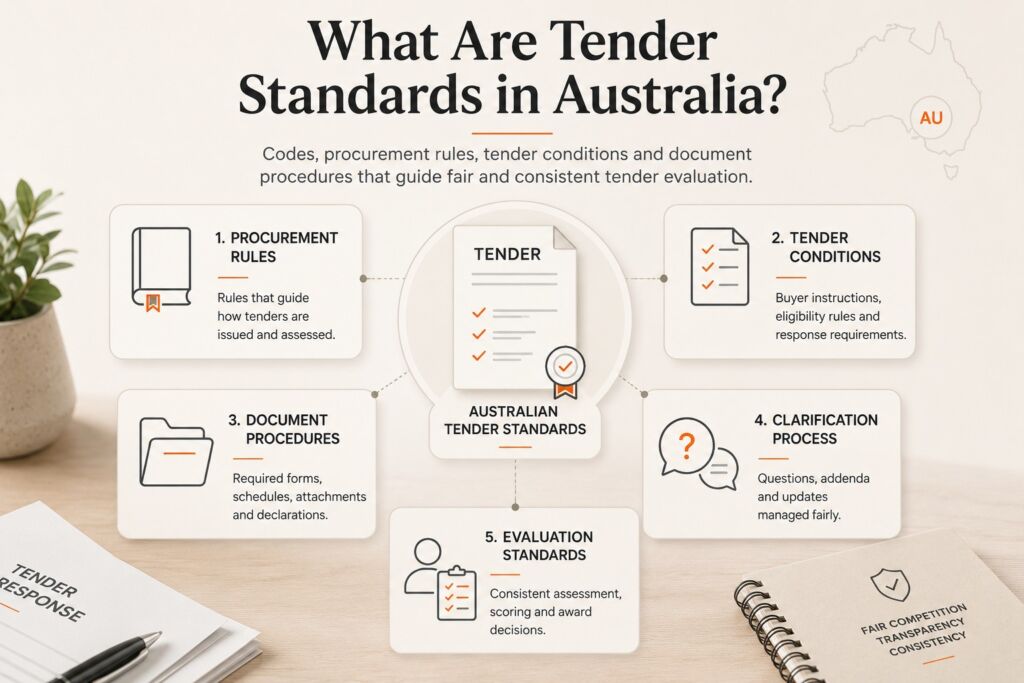
Tender standards in Australia are the codes, procurement rules, tender conditions and document procedures that govern how buyers issue, clarify, assess and award tenders. They create a shared framework for fair competition, clear response requirements and consistent evaluation.
- Conduct standards define ethical tender behaviour, probity, confidentiality and equal information access.
- Document standards define the RFT conditions, scope of works, specifications, response schedules and lodgement requirements.
- Response standards define the information, evidence, format and declarations a supplier submits.
- Evaluation standards define mandatory criteria, weighted criteria, price assessment and value-for-money comparison.
What Is AS 4120 Code of Tendering?
AS 4120 Code of Tendering is the Australian Standard that sets out principles for fair and ethical tendering conduct. Standards Australia lists AS 4120 as the Code of Tendering, and construction and professional practice sources often reference it when describing clear tender documents, consistent treatment and transparent evaluation.
AS 4120 supports five tender conduct attributes:
- Clear tender documents with defined conditions, scope and response requirements.
- Equal access to tender information through consistent communications and formal addenda.
- Fair evaluation against disclosed criteria and documented procedures.
- Transparent handling of submissions, clarifications and alternative offers.
- Ethical conduct by buyers, tenderers and advisers during the procurement process.
AS 4120 explains tendering conduct. The issued RFT, procurement policy and contract conditions still control the specific obligations for a live submission.
Do the Same Tender Standards Apply to Every Australian Tender?
The same tender standards do not apply to every Australian tender because each tender takes its rules from the buyer, jurisdiction, industry, value threshold, procurement method and issued documents. A Commonwealth open tender, a state construction tender and a private sector RFP each use different policies, forms and evaluation procedures. The supplier response follows the documents issued for that opportunity first, then uses AS 4120 and procurement guidance as context.
Which Government Procurement Rules Affect Tender Standards?
Government procurement rules affect tender standards by defining how public buyers select suppliers, disclose requirements, manage competition and document value for money. Suppliers use these rules to understand the assessment environment behind the RFT.
- Commonwealth procurement rules set national public-sector expectations for value for money, open competition, limited tender conditions and accountable decision-making.
- State and territory policies define local procurement thresholds, construction guidance, panel rules, reporting obligations and supplier conduct requirements.
- Open tender rules require public release of the opportunity, equal access to documents and consistent closing arrangements.
- Limited tender rules restrict the supplier pool under defined conditions, such as urgency, specialist capability or permitted procurement exceptions.
- Value-for-money rules assess price, quality, risk, whole-of-life cost, capability, compliance and delivery confidence.
- Supplier obligations require accurate declarations, complete schedules, conflict disclosure, valid evidence and compliant lodgement.
Government tender standards are buyer-facing in policy documents, but they become supplier obligations inside the tender conditions, evaluation criteria and response schedules.
How Are Tender Standards Different From Contract Standards?
Tender standards control how the procurement process runs before award, while contract standards control the legal and technical obligations after the buyer awards the contract. Suppliers read both because a tender response often confirms acceptance of the proposed contract form.
| Standard type | Purpose | Examples | Supplier impact |
| Tendering conduct standard | Governs fair issue, clarification, submission and evaluation of tenders | AS 4120 Code of Tendering, procurement policies, conditions of tender | Controls response format, deadlines, clarifications, departures and evaluation conduct |
| Contract form standard | Governs the contract terms after award | AS 2124, AS 4000, AS 4300, special conditions | Controls risk allocation, payment terms, variations, warranties, indemnities and dispute processes |
| Technical standard | Governs the goods, works or services specified in the scope | Australian Standards, international standards, project specifications | Controls evidence, methodology, certifications, testing and acceptance criteria |
A compliant bid separates tender conduct, contract acceptance and technical compliance instead of treating every standard as the same requirement.
What Does Tender Documentation Include to Meet Tender Standards?
Tender documentation meets tender standards when it gives suppliers the conditions, scope, specifications, evaluation method, response forms and lodgement rules required to prepare a conforming submission. Suppliers use this checklist to audit the RFT pack before drafting.
- Conditions of tender: buyer rules for eligibility, site visits, clarifications, closing time, late tenders and alternative offers.
- Scope of works: required goods, services, deliverables, locations, timeframes and contract boundaries.
- Specifications: technical standards, performance requirements, acceptance criteria, drawings, schedules and quality requirements.
- Evaluation criteria: mandatory criteria, weighted criteria, price assessment, qualitative criteria and value-for-money factors.
- Response schedules: forms for pricing, methodology, experience, personnel, compliance, declarations and departures.
- Contract form: general conditions, special conditions, insurance clauses, indemnities, warranties and payment terms.
- Lodgement instructions: portal details, file formats, page limits, naming rules, signatures and closing date.
- Clarification process: question deadlines, authorised contact point, response publication method and addenda rules.
- Required attachments: licences, certificates, insurances, WHS documents, quality systems and project evidence.
A supplier response reflects the tender documentation when every answer maps to a document requirement, schedule or evaluation criterion.
How Do Specifications and Technical Standards Fit Into a Tender?
Specifications fit into a tender by converting the buyer’s required outcome into measurable technical, performance and acceptance requirements. A specification defines what the supplier delivers, which standards apply and how the buyer assesses compliance.
Technical requirements include Australian Standards, international standards, product standards, safety requirements, quality tolerances, testing methods and performance benchmarks. A supplier responds with direct evidence: method statements, product data sheets, certificates, licences, inspection records, quality plans or compliant alternatives. A vague claim of capability does not satisfy a specification unless the response links the claim to a stated requirement.
How Do Tender Standards Affect Evaluation Criteria?
Tender standards affect evaluation criteria by requiring clear assessment factors that the buyer applies consistently to every eligible submission. A supplier improves compliance by structuring the response around the same criteria used by the evaluation panel.
| Criteria type | What it checks | Supplier response evidence |
| Mandatory criteria | Minimum pass/fail requirements for eligibility | Completed forms, licences, insurances, declarations, accreditations and required registrations |
| Weighted qualitative criteria | Capability, methodology, experience, personnel and risk controls | Methodology response, project examples, team profiles, systems evidence and delivery plan |
| Price criteria | Tendered price, pricing structure and cost assumptions | Pricing schedule, rates, inclusions, exclusions and assumptions register |
| Value-for-money criteria | Balance of price, quality, risk, time and whole-of-life value | Executive summary, risk controls, quality evidence, delivery certainty and pricing explanation |
| Project-specific criteria | Requirements unique to the scope, buyer or location | Technical compliance, local delivery plan, plant availability, specialist credentials and acceptance criteria |
Evaluation criteria are not a background section. They are the scoring framework. A tender response mirrors the criteria order, labels each evidence item and avoids unsupported claims.
What Makes a Tender Conforming or Non-Conforming?
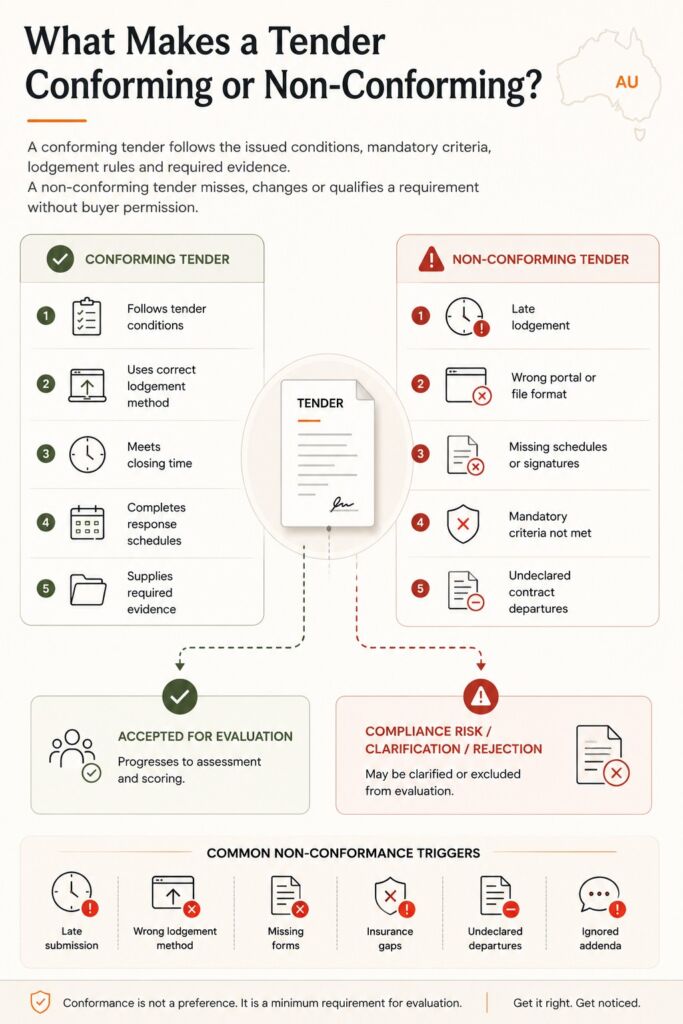
A conforming tender is a submission that follows the issued tender conditions, lodgement method, closing time, mandatory criteria, response schedules and required evidence. A non-conforming tender misses, changes or qualifies a requirement without buyer permission.
Common non-conformance triggers include:
- Late lodgement after the stated closing date and time.
- Wrong lodgement portal, email address, file format or file naming structure.
- Missing response schedules, unsigned declarations or incomplete pricing forms.
- Failure to meet a mandatory criterion, licence requirement or insurance requirement.
- Contract departures that are not declared in the required schedule.
- Alternative offers submitted without permission or without a conforming base offer.
- Addenda ignored during pricing, methodology or compliance review.
A supplier reduces non-conformance risk by checking each response item against the latest tender documents before lodgement.
How Are Tender Addenda and Clarifications Handled?
Tender addenda and clarifications are handled through formal version control, documented question responses and updates to every affected response schedule. Suppliers treat each addendum as a binding change to the tender pack.
- Monitor the tender portal and authorised contact channel until closing.
- Record each addendum number, issue date, changed clause and affected schedule.
- Update the compliance matrix, pricing schedule, methodology and attachments affected by the change.
- Save clarification responses with the tender file and share them with all response contributors.
- Check the final submission against the latest document version, revised closing time and published addenda.
Formal addenda protect probity by giving tenderers the same information. A supplier response that ignores an addendum risks pricing error, technical non-compliance or rejection.
Why Does Probity Matter in Tender Standards?
Probity matters in tender standards because it protects fairness, transparency, confidentiality, equal treatment and an auditable procurement record. A probity failure compromises the process even when the technical scope and price look complete.
- Confidentiality protects tender documents, supplier pricing, evaluation material and sensitive commercial information.
- Conflict management identifies personal, financial or organisational interests that affect tender decisions.
- Consistent communication prevents one tenderer from receiving information unavailable to others.
- Equal access requires questions, site visit details, clarifications and addenda to be managed through authorised channels.
- Audit trail records decisions, submissions, clarifications, scoring records and departure handling.
Suppliers support probity by using the nominated contact point, avoiding informal lobbying, recording clarification questions and submitting only authorised materials through the stated lodgement method.
What Evidence Shows a Tender Response Meets the Standard?
A tender response shows it meets the standard through mapped evidence that proves each mandatory requirement, evaluation criterion, technical specification and contract declaration. Evidence works when the evaluator connects it to a named requirement.
- Compliance matrix: each RFT requirement matched to a response section, attachment or schedule.
- Completed response schedules: pricing, departures, experience, personnel, methodology and declarations.
- Licences and registrations: trade licences, ASIC records, industry registrations and regulated activity approvals.
- Insurance evidence: public liability, professional indemnity, workers compensation and policy expiry details.
- Certifications and accreditations: ISO 9001, ISO 14001, WHS systems, quality systems and industry memberships.
- WHS documents: safety management plan, SWMS, incident procedures, training records and risk registers.
- Methodology evidence: delivery approach, programme, resources, controls, reporting and acceptance process.
- Project examples: client name, scope, contract value where approved, timeframe, outcome and relevance.
- Personnel profiles: role, qualifications, licences, experience, responsibilities and availability.
- Pricing schedule: rates, lump sums, assumptions, exclusions, provisional sums and GST treatment.
- Departures register: contract, technical and commercial departures declared in the required format.
Generic brochures and unsupported statements have low evidentiary value. A compliant submission labels each attachment and ties it to the scoring framework.
How Does a Capability Statement Support Tender Standard Compliance?
A capability statement supports tender standard compliance by summarising supplier proof in a format evaluators scan before reviewing detailed schedules. The document supports the evidence set when it reflects the tender criteria rather than general marketing language.
- Licences and registrations
- Insurance types and coverage details
- Certifications and accreditations
- Project evidence and completed contracts
- Key personnel and qualifications
- Service capacity, locations and delivery resources
A capability document does not replace the tender response. It supports the response by presenting verified supplier credentials in one structured profile.
What Tender Standard Mistakes Cause Bids to Fail?
Tender standard mistakes cause bids to fail when they create non-compliance, evaluation uncertainty, unsupported claims or unmanaged contractual risk. Each failure below has a direct prevention action.
- Missing mandatory schedules: complete every required form before writing narrative sections, then cross-check the schedule list against the RFT.
- Late submission: set an internal lodgement deadline before the buyer’s closing time and allow a portal upload buffer.
- Ignored addenda: maintain an addenda register and update pricing, methodology, scope responses and compliance answers.
- Unsupported compliance claims: attach licences, certificates, policies, project evidence or named examples for each claim.
- Unclear pricing: match the pricing schedule, define assumptions and declare exclusions in the permitted location.
- Undeclared contract departures: record every proposed departure in the required departures schedule.
- Non-compliant file format: follow naming rules, file size limits, portal instructions and signature requirements.
- Weak project evidence: select examples that match sector, scope, contract size, risk profile and delivery requirements.
- Criteria mismatch: structure the response around the evaluation criteria instead of a generic company profile.
- Informal communication: use the authorised contact point and keep clarification records with the submission file.
How Do Suppliers Check a Tender Before Submission?
Suppliers check a tender before submission through a standards-based review that confirms document version, mandatory criteria, evidence mapping, pricing, addenda, file requirements and final approval. The review creates a final audit trail before lodgement.
- Confirm the current document set: compare the RFT, specifications, schedules, contract form and all addenda against the tender portal.
- Check every mandatory criterion: verify licences, insurances, certifications, declarations and eligibility requirements.
- Complete every response schedule: review pricing, methodology, experience, personnel, departures and compliance forms.
- Map evidence to criteria: link each attachment to a requirement, criterion or schedule reference.
- Review pricing consistency: compare pricing tables, assumptions, GST treatment, exclusions and scope inclusions.
- Recheck addenda: confirm each addendum change appears in the technical response, methodology and price.
- Test file requirements: confirm file names, formats, page limits, signatures, upload size and portal access.
- Obtain internal sign-off: record final approval from the authorised person before lodgement.
- Lodge with a buffer: submit before the closing time and save the portal receipt or confirmation record.
When Does a Business Get Help Interpreting Tender Standards?
A business gets help interpreting tender standards when the RFT contains unfamiliar Australian Standards, construction contract forms, government procurement rules, high-value risk, mandatory compliance gaps or complex departures. Expert input is most useful before pricing and methodology are finalised.
Use a tender consultant, contract adviser or subject-matter specialist when the submission includes:
- AS 4120, AS 2124, AS 4000, AS 4300 or project-specific contract conditions.
- Government procurement rules, panel requirements or probity restrictions.
- Mandatory licences, insurances, certifications or WHS evidence gaps.
- Technical specifications with acceptance criteria or testing requirements.
- Contract departures, alternative offers or unclear risk allocation.
- A high-value bid with limited internal tender-writing capacity.
Tender standards, tender documentation, evaluation criteria, probity controls and evidence checks all connect to the same outcome: a supplier response that satisfies the issued requirements and gives evaluators a clear compliance trail.