





Tender compliance gives Australian suppliers a clear way to check whether a bid meets buyer instructions before the response reaches evaluation. A compliant tender addresses mandatory requirements, uses a compliance matrix, supplies the right documents and evidence, follows Australian procurement rules, checks technical and commercial obligations, meets submission rules and passes a final review before lodgement. This guide stays focused on supplier-side tender compliance, not broad procurement law or a full tender writing process.
What Is Tender Compliance?
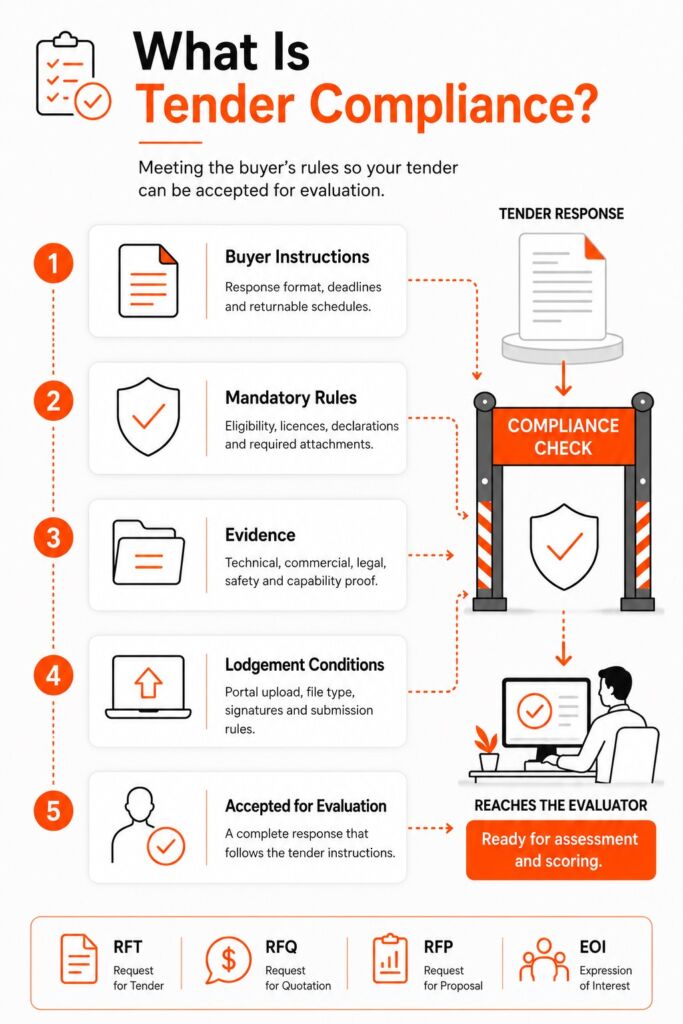
Tender compliance means meeting the buyer’s mandatory rules, document requirements and submission instructions so the tender can be accepted for evaluation.
- Buyer instructions set the required response format, lodgement method, deadlines and returnable schedules.
- Mandatory rules define pass-fail conditions such as eligibility, licences, declarations and required attachments.
- Evidence proves that the supplier meets technical, commercial, legal, safety and capability requirements.
- Lodgement conditions control how the tender response reaches the buyer, including portal upload, file type and signatures.
A compliant response gives the evaluator a complete submission that follows the RFT, RFQ, RFP or EOI instructions. An RFT is a request for tender, an RFQ is a request for quotation, an RFP is a request for proposal and an EOI is an expression of interest.
What Makes A Tender Compliant Or Non-Compliant?
A tender is compliant when the response satisfies every mandatory instruction that controls eligibility, evaluation and lodgement. A tender becomes non-compliant when a required item is missing, late, incomplete, unsigned or inconsistent with the buyer’s tender pack.
The practical distinction for suppliers is shown below.
| Tender status | Eligibility | Evaluation risk | Likely outcome | Prevention action |
| Compliant tender | Meets mandatory rules | Low | Accepted for evaluation | Map each requirement before drafting |
| Partially compliant tender | Meets some rules | Medium to high | Clarification or scoring loss | Flag gaps early and confirm buyer instructions |
| Non-compliant tender | Misses a mandatory rule | High | Rejection or exclusion | Run a final compliance audit before lodgement |
Evaluation criteria are the scored requirements the buyer uses to compare eligible responses. Mandatory requirements sit before scoring because they decide whether the tender response reaches evaluation.
Which Tender Requirements Must Be Checked Before Writing?
Mandatory tender requirements are the pass-fail conditions, returnable schedules, attachments, declarations, certificates and lodgement rules that control whether the response remains eligible.
- Check eligibility rules: ABN status, licence conditions, insurance coverage, accreditation and supplier registration.
- Check returnable schedules: signed forms, pricing schedules, declarations, conflict of interest forms and compliance statements.
- Check required attachments: certificates, policies, resumes, case studies, financial documents and safety records.
- Check deadlines: closing date, closing time, time zone, briefing dates and clarification cut-off dates.
- Check declarations: workplace, modern slavery, privacy, confidentiality and subcontractor declarations.
- Check certifications: ISO, WHS, environmental, industry licence and policy certificate requirements.
- Check submission instructions: portal name, upload format, file naming, page limits, word limits and signature rules.
Desirable criteria and weighted criteria still affect the score, but mandatory criteria control eligibility. The tender pack is the source of truth for both categories.
How Do You Check Mandatory Tender Requirements?
Mandatory tender requirements are checked by turning the tender pack into a requirement register before any drafting starts.
- Read the tender pack, including instructions, schedules, draft contract, addenda and portal notes.
- Mark language that signals obligation, including mandatory, required, submit, attach, sign, certify and complete.
- Create a requirement register with each criterion, reference number, evidence item, owner and due date.
- Assign evidence owners for insurance, licences, finance, technical methodology, safety and project examples.
- Confirm every mandatory item before drafting starts so the bid writer writes to the correct evidence set.
How Do You Build A Tender Compliance Matrix?
A tender compliance matrix is a working control that maps every tender requirement to its response location, evidence owner, status and reviewer.
A useful matrix includes these fields.
| Field | What it records |
| Requirement | The exact instruction, criterion or schedule item |
| Tender reference | The page, clause, section or attachment source |
| Response location | The draft section, appendix or file where the response appears |
| Evidence required | The document, certificate, case study, policy or statement required |
| Owner | The person responsible for supplying or approving the evidence |
| Status | Not started, drafted, checked, approved or lodged |
| Reviewer | The person who confirms that the response satisfies the requirement |
The matrix belongs in the bid control process, not the final written response unless the tender requests it. It gives the bid team a single view of requirements, evidence, approvals and review status.
How Does A Compliance Matrix Reduce Tender Risk?
A compliance matrix reduces tender risk by making missing requirements, unclear ownership and outdated response sections visible before submission.
- It links each requirement to a tender reference and draft location.
- It exposes missing attachments before the final upload.
- It assigns evidence owners for certificates, policies, case studies and pricing schedules.
- It tracks version control when addenda change the buyer’s instructions.
- It gives reviewers a direct path from requirement to response.
What Documents And Evidence Prove Tender Compliance?
Tender compliance evidence is the set of documents, certificates, declarations, schedules and proof points that show the supplier satisfies the tender requirements.
- Legal evidence: ABN details, ASIC extract, signed declarations, privacy documents and conflict of interest forms.
- Financial evidence: pricing schedule, financial statements, bank details, payment terms and solvency declarations.
- Insurance evidence: public liability, professional indemnity, workers compensation and policy expiry details.
- Capability evidence: case studies, project examples, references, capability statement and key personnel profiles.
- Safety evidence: WHS policies, safe work method statements, incident records and safety certifications.
- Technical evidence: methodology, specifications, equipment lists, quality procedures and delivery plans.
- Signed schedule evidence: completed forms, addenda acknowledgements, subcontractor schedules and contract departures.
The exact evidence list comes from the tender documents. A supplier-owned template helps organise evidence, but the buyer’s instructions override previous bid files.
How Can A Capability Statement Support Tender Compliance?
A capability statement supports tender compliance by giving the bid team a current evidence source for supplier capability, project history, licences, certifications and key personnel.
- It records company details, ABN information, service categories and operating locations.
- It summarises relevant projects, client types, contract scopes and delivery outcomes.
- It stores licences, insurances, accreditations and certification details in one document.
- It gives the tender writer consistent wording for capability sections without replacing tender-specific answers.
Which Australian Tender Compliance Requirements Matter Most?
Australian tender compliance requirements depend on the buyer, jurisdiction, procurement method, tender value and policy conditions written into the tender pack.
- Commonwealth Procurement Rules: CPRs are Australian Government rules for non-corporate Commonwealth entities and prescribed corporate Commonwealth entities.
- Government portals: federal, state and local buyers use tender portals with specific upload, registration and closing-time rules.
- Probity expectations: probity means fairness, integrity and defensible decision-making in procurement processes.
- Agency-specific rules: departments and councils add requirements for security, safety, insurance, confidentiality and reporting.
- State requirements: state tenders include local policies, industry participation rules, safety obligations and social procurement conditions.
- Policy-linked certificates: some tenders require evidence such as WGEA compliance, modern slavery declarations or local jobs policy statements.
This section provides content guidance, not legal advice. The tender documents and buyer clarifications remain the controlling source for each submission.
When Do WGEA Or Policy Compliance Certificates Matter?
WGEA or policy compliance certificates matter when the tender documents, buyer policy or government procurement rules make the certificate an eligibility requirement. WGEA is the Workplace Gender Equality Agency. Relevant employers tendering for some government contracts receive certificate requirements through the buyer’s tender pack.
How Do Technical And Commercial Checks Affect Tender Compliance?
Technical and commercial checks affect tender compliance because a response that meets document rules still fails when the proposed solution or pricing conditions breach the buyer’s requirements.
| Technical compliance checks | Commercial compliance checks |
| Confirm the methodology addresses the scope, specifications and performance standards. | Confirm the pricing schedule matches the buyer’s required format and currency. |
| Map equipment, personnel, timelines and deliverables to the specification. | Record assumptions, exclusions, contract departures and payment terms clearly. |
| Check licences, safety systems, quality procedures and technical certifications. | Check value-for-money statements, warranties, insurances and subcontractor pricing. |
| Verify the response answers each technical criterion with evidence. | Verify commercial forms are signed, complete and consistent with the written response. |
A contract departure is a proposed change to the buyer’s draft contract. Assumptions are conditions the supplier relies on when pricing or delivering the work. Both items belong in the compliance review.
Which Submission Rules Can Make A Tender Non-Compliant?
Submission rules make a tender non-compliant when the bid misses a required deadline, format, signature, upload step or buyer instruction.
- Deadline: submit before the closing date, closing time and stated time zone.
- Portal upload: use the nominated procurement portal and confirm upload completion.
- File naming: follow the required naming convention for each file or attachment.
- File type: submit Word, PDF, Excel or zipped files only where the tender allows them.
- Signatures: include required signatures, witness details and authorised representative names.
- Page limits: keep responses within specified page counts and attachment limits.
- Word limits: keep answers inside stated word counts for each criterion.
- Addenda acknowledgement: confirm that every buyer update has been reviewed and addressed.
- Required forms: complete every schedule, declaration and pricing table listed as returnable.
How Is A Tender Compliance Review Done Before Submission?
A tender compliance review is done by checking requirements, evidence, approvals, formatting and lodgement conditions before the response reaches the buyer.
- Review the tender documents and confirm the current addenda version.
- Update the compliance matrix with every mandatory item and scored criterion.
- Verify evidence against the tender pack, including certificates, declarations, licences and schedules.
- Run an independent check by a reviewer who did not draft the response.
- Confirm management, legal, commercial, finance and technical approvals where the tender requires them.
- Check file names, page limits, word counts, signatures, attachment order and formatting.
- Test the portal upload process before the closing period becomes time-critical.
- Record final lodgement confirmation, receipt number, upload time and submitted file list.
How Are Clarification Questions And Addenda Managed?
Clarification questions and addenda are managed by tracking every buyer update as a compliance control inside the bid process.
- Nominate one person to monitor the portal, buyer emails and clarification register.
- Log each buyer update with its date, source, affected requirement and response owner.
- Update the compliance matrix and draft response after each addendum.
- Remove outdated assumptions from pricing, methodology and evidence sections.
What Common Mistakes Make Tenders Non-Compliant?
Common tender compliance mistakes are missed instructions, incomplete evidence, unsupported claims, late submission and weak review controls.
- Missing the deadline. Prevention: set an internal deadline at least one business day before the buyer’s closing time.
- Leaving criteria unanswered. Prevention: map every criterion to a draft response location and reviewer.
- Omitting attachments. Prevention: create an attachment register from the tender pack and check it before upload.
- Making unsupported claims. Prevention: attach evidence such as certificates, case studies, policies and references.
- Copying previous bids. Prevention: rewrite reused content against the current buyer’s scope, criteria and risks.
- Breaking format rules. Prevention: check page limits, file names, file types, signatures and schedule formats.
- Ignoring addenda. Prevention: record every buyer update and revise the response before final review.
- Leaving review too late. Prevention: complete compliance, technical and commercial reviews before final formatting.
What Does A Final Tender Compliance Checklist Include?
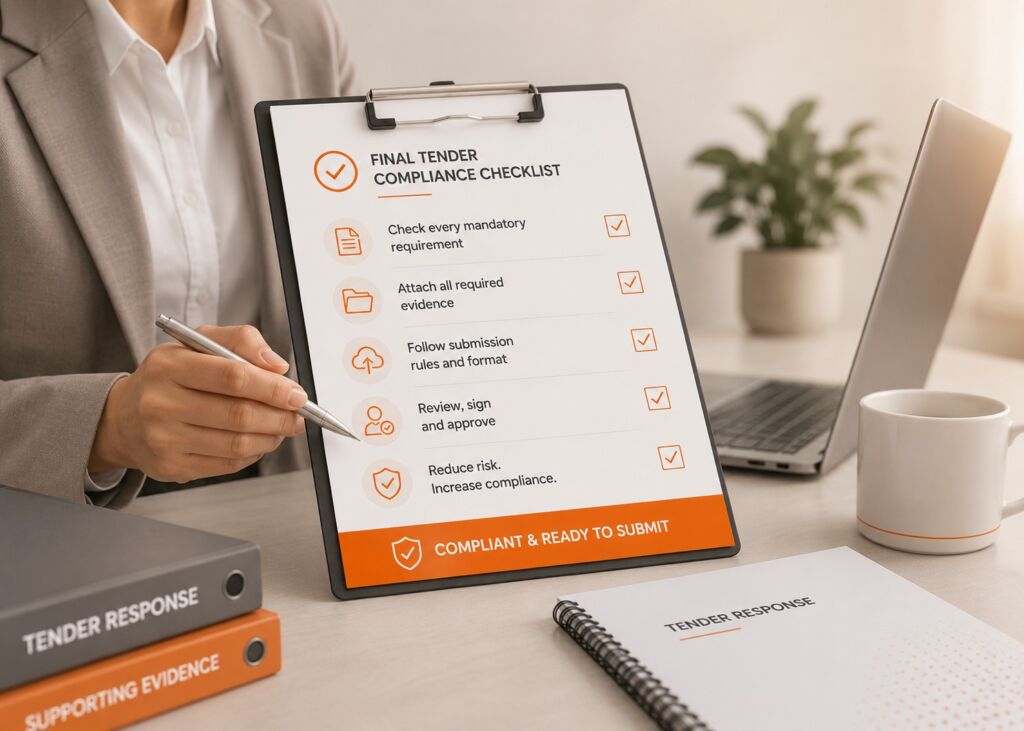
A final tender compliance checklist includes requirement checks, evidence checks, matrix checks, approval checks, formatting checks and lodgement checks.
- Requirements: confirm every mandatory criterion, schedule, declaration, attachment and instruction has been addressed.
- Evidence: confirm certificates, licences, insurances, case studies, policies, resumes and pricing schedules are current.
- Matrix: confirm every matrix row has a response location, evidence owner, status and reviewer.
- Technical and commercial: confirm methodology, specifications, contract departures, assumptions and pricing match the tender pack.
- Australian policy: confirm CPR, WGEA, probity, local jobs, safety and agency-specific requirements where listed.
- Approvals: confirm legal, finance, technical, management and authorised signatory approvals are complete.
- Formatting: confirm page limits, word limits, file names, file types, signatures and attachment order.
- Lodgement: confirm portal access, upload status, receipt number, submission time and submitted file list.
The checklist closes the compliance loop started in the opening review. It brings tender compliance, Australian tender requirements, mandatory evidence, compliance review and tender checklist controls into one final submission test.
Can A Small Compliance Mistake Get A Tender Rejected?
YES, a small compliance mistake gets a tender rejected when the mistake breaches a mandatory requirement, deadline, attachment rule or lodgement instruction. Minor issues sometimes receive clarification, but suppliers do not control buyer discretion.
Is Tender Compliance The Same As Tender Writing?
NO, tender compliance is not the same as tender writing. Compliance checks whether the response meets the rules. Tender writing also covers persuasive structure, win themes, evidence selection and evaluator clarity.
Can A Tender Be Submitted Without Every Attachment?
NO, a tender cannot be submitted safely without every required attachment unless the buyer confirms that the item is optional or not applicable. Missing mandatory attachments create non-compliance even when the written answers are strong.
Does Every Tender Use A Compliance Checklist?
YES, every tender uses a compliance checklist when the supplier wants a repeatable pre-submission review. The checklist must be customised from the current tender pack because each buyer sets different documents, lodgement rules and evidence requirements.
Can AI Check Tender Compliance Reliably?
NO, AI cannot check tender compliance reliably on its own. AI tools assist with gap spotting, requirement summaries and draft consistency checks. A human reviewer verifies obligations, attachments, evidence, confidentiality and buyer instructions.
Can A Tender Writer Guarantee Compliance?
NO, a tender writer cannot guarantee tender compliance alone. Compliance depends on accurate business evidence, legal input, commercial review, management approvals and final lodgement by the authorised supplier representative.