


TL;DR
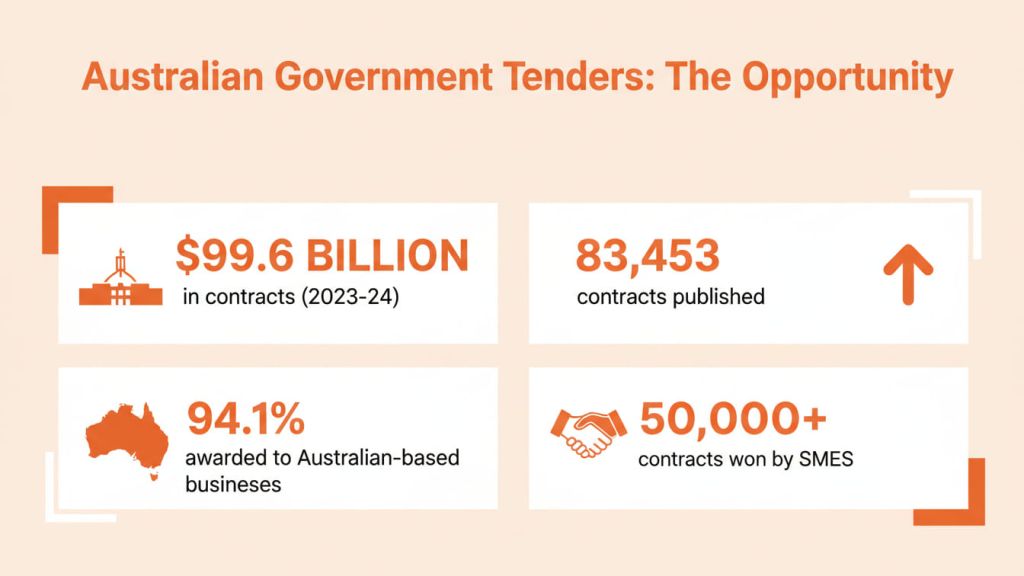
Government tenders in Australia are found primarily through AusTender (federal) and state-specific portals like buy.nsw.gov.au and tenders.vic.gov.au. The Australian Government published 83,453 contracts worth $99.6 billion in 2023-24, with SMEs securing over 50,000 of those contracts.
This guide is for Australian business owners and procurement managers who want to understand where to find opportunities, what evaluators actually score, and how to avoid the compliance failures that knock out 60% of submissions before they’re even read.
The surprising part? Winning isn’t about being the cheapest—it’s about proving you understand their specific problem.
Key Takeaways
✓ Register on AusTender and your home state portal today. Set up email notifications for your UNSPSC categories—over 200 federal opportunities publish weekly.
✓ Prepare compliance documents before tenders drop. Insurance certificates, management system documentation, and capability statements take 2–6 weeks to gather properly.
✓ Start writing on day one of every tender window. Most businesses underestimate preparation time by 50%. A standard 10–15 criteria tender requires 40–80 hours of work.
✓ Answer the specific contract, not your company history. Evaluators score your understanding of their problem, not generic capability descriptions.
✓ Create a compliance checklist and check it twice. 60% of tenders fail before evaluation due to late submission, missing attachments, or exceeding page limits.
✓ Request a debrief for every tender—win or lose. Systematic feedback review can improve win rates from 12% to 34% over 18 months.
✓ Apply a disciplined bid/no-bid framework. Submitting five quality tenders beats submitting fifteen rushed ones. Your reputation follows you.
The Australian Government awarded $99.6 billion in contracts last financial year. Here’s what most businesses miss: 94.1% of those contracts went to businesses with Australian addresses. That’s not a typo. The opportunity is massive, local, and grossly underutilised by capable Australian businesses.
Picture this: You’re running a Brisbane-based engineering firm with a strong track record across complex projects. You submit your first government tender, wait eight weeks, then discover you were disqualified because your insurance certificate expired three days before close.
Government procurement plays by very different rules. There are no relationship shortcuts, no coffee meetings, and no flexibility around deadlines. Evaluators can only score what’s written against the published criteria, and even a 60-second late submission must be rejected under legislation.
By the end of this guide, you’ll know where to find tender opportunities, how evaluators score, and how to build a tender pipeline that doesn’t exhaust your team.
Where Can You Find Government Tenders in Australia?
Government tender opportunities are published across multiple portals, and most businesses only monitor one of them. That’s a problem when NSW alone awarded $26.8 billion in tenders during 2020-21. The federal system is your starting point, but state portals are where many SMEs find less competition and higher win rates.
What Is AusTender and How Does Registration Work?
AusTender (tenders.gov.au) is the federal government’s centralised procurement system. Every Commonwealth entity must publish open tenders here. Registration is free and takes about 15–20 minutes.
You’ll need your ABN, business contact details, and UNSPSC codes matching your service categories. Those codes matter—they determine which opportunities hit your inbox. Get them wrong, and you’ll miss relevant tenders entirely.
Here’s the critical step most skip: Set up email notifications for your UNSPSC categories immediately after registration. Over 200 opportunities publish weekly on AusTender. Without alerts, you’ll miss 25-day response windows before you even know they existed.
The thresholds you need to know:
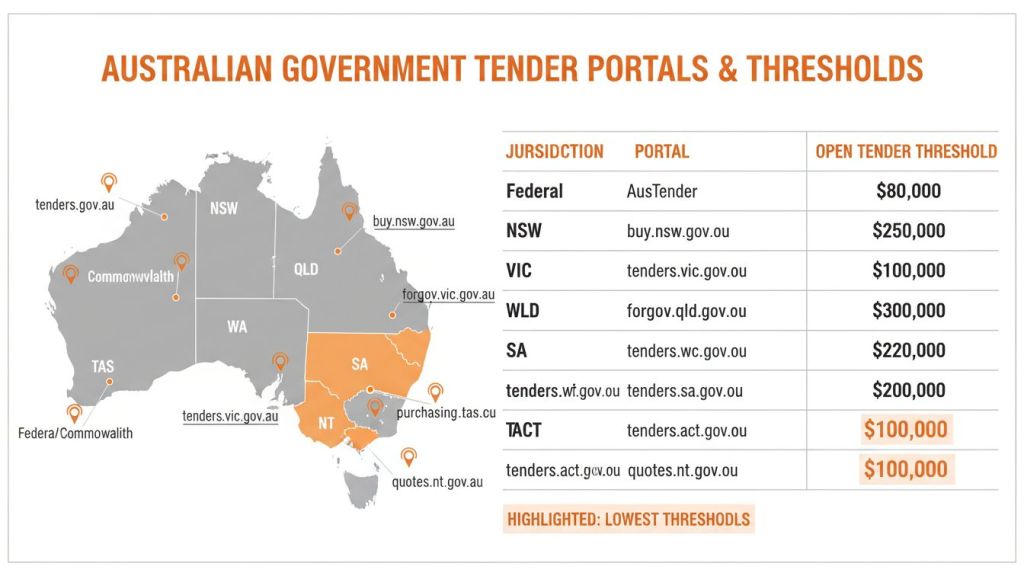
- $80,000+: Open tender required for most non-corporate Commonwealth entities
- $400,000+: Open tender required for corporate Commonwealth entities
- Under $80,000: Limited tender permitted—agencies can approach suppliers directly
That last point matters. If you’re not on an agency’s radar for smaller contracts, you’re invisible for direct approaches. Building relationships through industry briefings and capability statements fills that gap.
Which State Government Portals Should You Monitor?
| State/Territory | Portal | Threshold for Open Tender |
| NSW | buy.nsw.gov.au | $250,000 (goods/services), $1M (construction) |
| VIC | tenders.vic.gov.au | $100,000 (general), $200,000 (construction) |
| QLD | forgov.qld.gov.au | $300,000 |
| WA | tenders.wa.gov.au | $250,000 |
| SA | tenders.sa.gov.au | $220,000 |
| TAS | purchasing.tas.gov.au | $250,000 |
| ACT | tenders.act.gov.au | $200,000 |
| NT | quotes.nt.gov.au | $100,000 |
Here’s what most competitors get wrong: They register on AusTender and call it done. Meanwhile, NSW Government procurement dwarfs many federal agencies. The Northern Territory awards 89% of contracts to local suppliers—if you’re based in Darwin or Alice Springs, that’s your competitive moat.
Victoria’s lower threshold ($100,000) means more opportunities hit the open market. Queensland’s higher threshold ($300,000) means more work goes to pre-qualified panels. Know the landscape before you pick your battleground.
Are Third-Party Tender Aggregators Worth Paying For?
Services like Australian Tenders, TenderLink, and TendersInfo charge $50–$500/month to aggregate opportunities across jurisdictions. They save time. The question is whether that time saving justifies the cost.
When it’s worth it: You’re targeting three or more states simultaneously and your team can’t realistically monitor multiple portals daily. The aggregation saves 3–5 hours weekly in portal checking.
When it’s not: You’re focused on one jurisdiction or federal-only work. AusTender’s free email alerts do the job. Spending $3,000 annually on aggregation when you’re only chasing federal contracts is money better spent on tender writing support.
A practical approach is to start with free alerts on AusTender and your home state portal. Add a paid aggregator only when your submission volume increases—typically once you’re chasing opportunities across multiple jurisdictions.
What Does the Government Tender Process Actually Look Like?
The procurement process follows a rigid structure. Understanding each stage helps you prepare smarter and avoid the timing mistakes that catch most first-time tenderers off guard.
What Are the Five Stages of Government Procurement?
Stage 1: Planning (4–12 weeks before publication)
The agency defines its needs, drafts specifications, and sets the evaluation criteria. Most of the key decisions are made here—well before a tender becomes public.
Annual Procurement Plans on AusTender provide early visibility, often 30 days ahead. Many suppliers overlook these, but they offer valuable lead time to prepare capability statements, update references, and secure subcontractors.
Stage 2: Approach to Market (25–45 days open period)
Commonwealth Procurement Rules mandate minimum 25 days for open tenders. Complex procurements run 6–8 weeks. The clock starts when the ATM publishes—not when you download documents, not when you first read them, and definitely not when you finally start writing.
Stage 3: Evaluation (2–8 weeks post-close)
Evaluation panels score responses against published criteria. You won’t hear anything during this phase. Clarification questions may extend the timeline, but “no news” is genuinely just “no news”—not a signal either way.
Stage 4: Contract Negotiation (1–4 weeks)
The preferred supplier finalises terms. Don’t celebrate yet. I’ve watched contracts fall over at this stage more often than you’d expect—usually over insurance requirements, liability caps, or IP ownership disputes.
Stage 5: Contract Award
Published on AusTender within 42 days of signing. Unsuccessful tenderers can request debriefs. Always request one.
What Do Evaluation Panels Actually Score?
Government evaluators use weighted criteria published in the Request for Tender. These weightings aren’t decorative—they determine exactly how your response gets scored.
| Criterion | Typical Weighting | What Evaluators Look For |
| Capability & Experience | 25–35% | Evidence of similar completed projects (last 3 years), named personnel, qualifications |
| Methodology/Approach | 20–30% | Specific understanding of this project, not generic process descriptions |
| Price | 20–40% | Value for money (not always cheapest), breakdown transparency |
| Risk Management | 10–20% | WHS systems, insurance currency, business continuity |
| Local Content/Social | 5–15% | SME engagement, Indigenous participation, sustainability |
Truth is, most competitors describe what they do instead of how they’ll deliver this specific contract. Evaluators score your understanding of their problem, not your company history. A three-page company overview scores zero if it doesn’t address evaluation criteria.
Check this out: According to the Department of Finance, evaluation panels must assess responses only against published criteria. They can’t give points for reputation, past relationships, or anything not explicitly stated in the RFT. That’s your opportunity—criteria-driven responses beat reputation every time.
How Do You Write a Government Tender Response That Wins?
Writing a winning tender starts weeks before the opportunity even publishes. The businesses that consistently win aren’t better writers—they’re better prepared.
What Supporting Documents Do You Need Before You Start?
Don’t wait until a tender drops to gather these. Most take 2–6 weeks to obtain, and scrambling at the last minute shows in your submission quality.
Compliance essentials (almost always required):
- Certificate of Currency: Public Liability ($10M–$20M typical), Professional Indemnity, Workers’ Compensation
- ABN registration and current ASIC extract
- Modern Slavery Statement (for contracts $50M+ or federal reporting entities)
- WHS Management System documentation
- Quality Management System (ISO 9001 preferred but not always mandatory)
Competitive differentiators:
- Environmental Management System (ISO 14001)
- Reconciliation Action Plan (RAP) or Indigenous Engagement Plan
- Cyber security certifications (ISO 27001, Essential Eight compliance)
Cost to prepare: $5,000–$15,000 if you need external help establishing management systems. $500–$2,000/year for insurance certificate renewals. That sounds like a lot until you compare it to the value of contracts you’re chasing.
How Long Does Writing a Quality Tender Response Take?
Based on 200+ tenders I’ve worked on, here’s what realistic timeframes look like:
| Tender Complexity | Internal Hours | Elapsed Calendar Days |
| Simple RFQ (under $100K) | 8–20 hours | 3–5 days |
| Standard RFT (10–15 criteria) | 40–80 hours | 10–15 days |
| Complex RFT (20+ criteria, site visits, presentations) | 100–200 hours | 20–30 days |
Here’s the uncomfortable truth: Most businesses underestimate by 50%. They start writing two weeks before close, run out of time, and submit rushed responses missing key evidence.
I watched a Melbourne IT services firm lose a $1.2M contract because they started writing on day 18 of a 25-day window. Their methodology section—worth 30% of the score—read like a first draft. Because it was.
Start on day one. Not day three. Not “once we’ve read through everything properly.” Day one.
What’s the Real Cost of Professional Tender Writing?
| Service Level | Price Range (AUD + GST) | What You Get |
| Review & Edit Only | $1,500–$3,000 | Feedback and proofreading on your draft |
| Partial Writing Support | $3,000–$8,000 | Writer completes specific sections (methodology, capability) |
| Full Tender Management | $8,000–$20,000+ | End-to-end response including project management, graphics, compliance |
Source: Industry pricing from The Tender Team, Tender Writers, MyConsulting (2024-25 rates).
Here’s the ROI calculation that matters: A $500,000 contract with 20% win rate improvement (from 15% to 35%) yields $100,000 expected value increase. An $8,000 tender writing fee represents 8% of that value. When you frame it that way, the question becomes “can I afford not to get help?”
What Are the Biggest Mistakes in Government Tendering?
After 16 years of writing tender responses, I’ve seen the same mistakes sink capable businesses. The frustrating part? They’re all preventable.
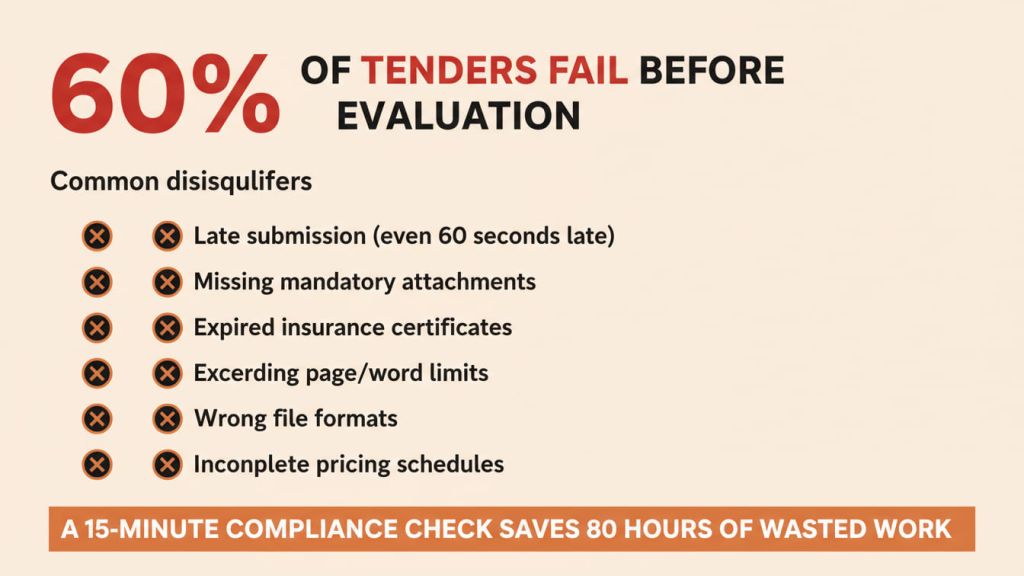
Why Do 60% of Tenders Fail Before Evaluation?
Non-compliance. The automated system doesn’t care about your 20-year track record. Common disqualifiers include:
- Late submission (even 60 seconds late = automatic rejection)
- Missing mandatory attachments (insurance certificates, signed declaration forms)
- Exceeding page/word limits (evaluators stop reading at the limit—your brilliant conclusion on page 21 of a 20-page limit gets zero points)
- Wrong file formats (PDF required, submitted Word doc)
- Incomplete pricing schedules (missing line items = non-compliant)
I once saw a Brisbane construction firm lose a $2.4M contract because the insurance certificate they uploaded had expired three days earlier—even though the policy had already been renewed. A simple compliance check would have prevented it.
The fix is boring but essential: Create a compliance checklist for every tender. Check it twice. Have someone else check it a third time. The 15 minutes you spend on compliance checking saves the 80 hours you spent writing.
What Does “Value for Money” Actually Mean to Government Buyers?
Value for money isn’t about choosing the cheapest option. Under the Commonwealth Procurement Rules, agencies consider fitness for purpose, performance history, flexibility, sustainability, and whole-of-life costs when assessing proposals.
- Fitness for the purpose of the proposed goods/services
- Potential supplier’s experience and performance history
- Flexibility to adapt if requirements change
- Environmental sustainability
- Whole-of-life costs (not just upfront price)
Case in point: A Perth IT services SME (15 employees) beat two multinational competitors on a $1.8M federal contract. They were 12% higher on initial implementation price. But they demonstrated superior local support response times (4-hour onsite vs 24-hour remote) and lower ongoing maintenance costs over the 5-year contract period.
The multinationals competed on brand and price. The SME competed on total value. The SME won.
How Can SMEs Compete Against Larger Businesses?
Small and medium enterprises have structural advantages in government procurement that most don’t realise exist. The policy environment has shifted significantly in favour of SMEs over the past five years.
What SME-Friendly Procurement Policies Exist?
The Australian Government is now mandated to:
- Source at least 20% of procurement value from SMEs (increased from 10% in July 2022)
- Award at least 35% of contracts up to $20M to SMEs
- Allow limited tender (direct approach) for SME purchases up to $500,000
The result? According to the Department of Finance, the Commonwealth contracted with 1,384 more SMEs in 2023-24 than in 2018-19. SME participation is at record levels.
These aren’t aspirational targets. Agencies report against them. Procurement officers know they’re being measured. That works in your favour.
Which Sectors Have the Highest SME Win Rates?
| Sector | SME Contract Win Rate | Total Value Won by SMEs |
| Engineering & Research Services | 59.3% | $8.58 billion |
| Building & Construction | 47.0% | $8.34 billion |
| IT & Telecommunications | 48.5% | $6.20 billion |
| Management & Business Services | 51.5% | $16.43 billion |
Source: Department of Finance, Statistics on Australian Government Procurement Contracts 2021-22.
Engineering and research services at 59.3% is remarkable. If you’re a specialist engineering consultancy, you’ve got better odds than a coin flip on every tender you submit—assuming your submission is competitive.
How Do You Position as a Credible Local Supplier?
State governments prioritise local content. Victoria’s Local Jobs First policy requires contractors to:
- Use local suppliers and subcontractors
- Employ local workers
- Engage apprentices and trainees
Here’s the practical application: Name your local subcontractors in your tender. Include their ABNs and postcodes. Quantify local spend percentages. Generic statements like “we support local businesses” score zero.
A Geelong manufacturing firm won a $3.2M Victorian Government contract by specifying that 78% of their supply chain (by value) was within 100km of the delivery site. They named 12 local suppliers with ABNs. Their competitor—a larger Melbourne firm—wrote two paragraphs about “commitment to local industry” without a single specific supplier named.
Specificity beats sentiment every time.
What Happens After You Submit a Government Tender?
The waiting period after submission feels like a black hole. Understanding what’s actually happening helps manage expectations and prepare for outcomes.
How Long Does Evaluation Take?
| Tender Type | Typical Evaluation Period |
| Simple quote (under $80K) | 1–2 weeks |
| Standard tender | 4–8 weeks |
| Complex/multi-stage tender | 8–16 weeks |
| Major infrastructure tender | 3–6 months |
You won’t hear anything during evaluation. Silence is normal. Resist the urge to contact the agency—it can be grounds for disqualification. Seriously. I’ve seen it happen. A phone call to “just check on progress” led to a formal complaint from a competitor about improper contact.
If they need clarification, they’ll ask. In writing. Through the formal tender system.
Should You Always Request a Debrief?
Yes. Always. Win or lose.
Unsuccessful tenderers can request detailed feedback within 10 business days of notification. You’ll learn:
- Your scores against each criterion
- Where you ranked relative to other bidders (not always disclosed, but often is)
- Specific weaknesses in your response
- What the winning submission did better
I’ve improved clients’ win rates from 12% to 34% over 18 months using debrief feedback systematically. Each debrief becomes a checklist for the next submission. The patterns become obvious: “We consistently score low on risk management. We need to strengthen that section.”
Agencies must provide debriefs but schedules vary—expect 2–4 weeks wait after requesting one.
What Are Your Rights If You Believe the Process Was Unfair?
The Government Procurement (Judicial Review) Act 2018 allows suppliers to seek review of certain procurement decisions. Grounds include:
- Evaluation criteria not applied as published
- Conflict of interest among evaluators
- Procedural fairness breaches
But here’s the reality check: Judicial review is expensive ($50,000+ in legal fees) and rarely succeeds. The debrief process is your practical accountability mechanism. Use it before considering legal options.
In my experience, genuine procedural failures are rare. More common is disappointment with subjective scoring—which isn’t reviewable. “We thought our methodology was better” isn’t grounds for review.
How Do You Build a Sustainable Government Tender Pipeline?
Sustainable tendering means winning enough to grow without burning out your team. That requires discipline about which opportunities to chase.
What’s a Realistic Win Rate to Target?
| Tenderer Experience Level | Realistic Win Rate |
| First-time tenderers | 5–15% |
| Established tenderers (1–3 years) | 15–25% |
| Experienced tenderers (3+ years) | 25–40% |
| Panel/preferred supplier status | 40–60% |
Here’s the maths that matters: At 20% win rate, you need to submit 5 tenders to expect 1 win. If each tender takes 60 hours to prepare, that’s 300 hours per win. Factor this into your business development budget.
If your average contract value is $200,000 and your win rate is 20%, each tender submission has an expected value of $40,000. That justifies significant investment in quality submissions—but also demands selectivity about which opportunities you chase.
When Should You Not Tender?
A structured bid/no-bid process protects your team’s time. It’s usually best not to tender when:
- You don’t meet mandatory requirements
- You’ve never done this type of work before
- The response window is under 10 days and you haven’t prepared
- You’re only submitting to “stay visible”
- The contract value doesn’t justify preparation costs
Submitting fewer, high-quality tenders almost always leads to better long-term results.
What’s Your Next Move?
The Australian Government published 83,453 contracts worth $99.6 billion last financial year. SMEs secured over 50,000 of those contracts. The opportunity is real, the policy environment favours smaller businesses, and the process—while rigorous—is learnable.
Three things will determine whether you win: preparation before tenders are published, specificity in addressing evaluation criteria, and discipline about which opportunities to chase. Get those right, and you’ll outperform 80% of your competitors who are still submitting generic responses two weeks before the deadline.
Start today. Register on AusTender if you haven’t. Download the Annual Procurement Plan for your industry. Gather your compliance documents. The next opportunity in your sector could be published this week.
FAQs
Where can I check for government tenders in Australia?
Federal government tenders above $80,000 are on AusTender (tenders.gov.au). State portals include buy.nsw.gov.au (NSW), tenders.vic.gov.au (Victoria), and forgov.qld.gov.au (Queensland). All platforms offer free registration. Immediately set up email alerts; otherwise, 25-day response windows will be missed.
How do I apply for government tenders?
Register on AusTender and state portals using your ABN/UNSPSC codes. Download documents, review requirements, and submit responses (including certificates of currency, capability evidence, pricing, and criterion responses) via the portal before the deadline. Expect 40–80 hours per standard tender.
How long does the government tender process take?
Tender process, from market approach to contract award, usually takes 10–20 weeks. Open tenders run for 25–45 days, followed by 4–8 weeks for standard evaluation and 1–4 weeks for contract negotiation. Complex or major procurements may take over 6 months. Upcoming opportunities are advertised 30 days in advance via Annual Procurement Plans on AusTender.
What percentage of government tenders do SMEs win?
In 2021-22, SMEs secured 30.8% ($80.8B) of Commonwealth procurement contracts, exceeding the mandated 20%. SME rates were notably higher in Engineering & Research (59.3%), Management & Business (51.5%), and IT & Telecommunications (48.5%).
How much does professional tender writing cost?
Review/editing services cost $1,500–$3,000. Partial writing support is $3,000–$8,000. Full tender management, including coordination and graphics, is $8,000–$20,000+. For an $8,000 investment in professional writing, improving a $500,000 contract’s win rate from 15% to 35% yields an expected value of $100,000.
What happens if I submit a tender late?
Government procurement systems strictly enforce deadlines. Late submissions, even by a minute, are automatically rejected with no exceptions or appeals. To avoid exclusion due to technical issues, submit at least 2–4 hours early. Many experienced tenderers submit 24 hours in advance.
Can I tender for government work without prior government experience?
Yes, but frame private sector experience carefully, highlighting comparable complexity, compliance, or stakeholder management. Private sector evidence can prove delivery capability, though your first government tender will be harder. Start with smaller contracts to build your government track record.
What is “value for money” in government procurement?
Value for money is not just the cheapest price. Commonwealth Procurement Rules define it by fitness for purpose, supplier history, flexibility, environmental sustainability, and whole-of-life costs. A slightly more expensive SME (e.g., 12% higher) offering faster local support and lower long-term maintenance can be chosen over a cheaper multinational.
How do I find out why my tender was unsuccessful?
Request a debrief within 10 business days of notification. Agencies must provide feedback on your scores, ranking, weaknesses, and the winning submission’s strengths. Debriefs usually take 2–4 weeks. Use this systematic feedback to improve future submissions.
Do I need special certifications to tender for government work?
Mandatory tender requirements usually include current insurance ($10M–$20M Public Liability, Professional Indemnity, Workers’ Compensation), WHS documentation, and ABN. Competitive advantages often involve ISO certifications (9001 Quality, 14001 Environmental, 27001 Information Security) and Reconciliation Action Plans (Indigenous engagement).


