


TL;DR
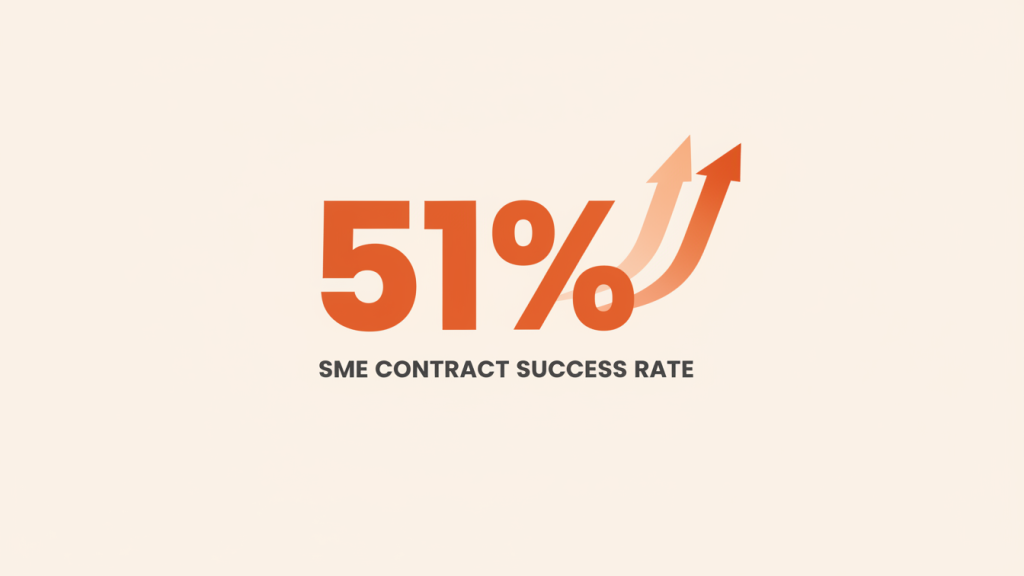
NSW Government tenders represent a $42 billion annual opportunity, with SMEs capturing $10.1 billion in 2023-24. December 2024 policy changes mean Supplier Hub registration is now mandatory, the direct procurement threshold sits at $250K, and contracts over $7.5M require local market testing. This guide covers where to find opportunities, how registration actually works, and what evaluation criteria win contracts. The surprise? 51% of contracts between $150K–$250K went to SMEs last year.
Key Takeaways
- Supplier Hub: Mandatory for >$150K; incomplete profiles reduce scores.
- ProcureAlert: Daily emails ensure quick opportunity capture.
- Target $150K–$250K: 51% SME success in 2024; agencies can engage directly.
- Prioritize Compliance: 60% of tender failures occur pre-evaluation (missing/incorrect docs).
- Local Content Story: Required for $7.5M+; document NSW suppliers, employees, and economic impact.
- Track End Dates: Re-tenders open 3–6 months prior to expiry.
- Request Debriefs: Learn from losses to secure future wins.
Where Are NSW Government Tenders Published?
Two portals. Linked, but not the same. This trips up most first-time suppliers.
The buy.nsw platform acts as the gateway. It’s where policy information lives, where suppliers register, and where the Supplier Hub is managed. NSW eTendering, on the other hand, is where live tender opportunities and contract disclosures actually appear.
From 31 December 2024, all open and selective procurements exceeding $150,000 must be published on buy.nsw’s Tenders module. NSW Procurement has allowed agencies until December 2025 to fully transition, which means both systems are still in active use.
Contracts valued over $150,000 are disclosed on NSW eTendering within 60 days of award. To avoid missing opportunities, suppliers need access to both platforms — and, critically, linked accounts.
What Is the Difference Between buy.nsw and eTendering?
| Platform | Purpose | What You’ll Find |
| buy.nsw (buy.nsw.gov.au) | Gateway | Policy info, Supplier Hub registration, procurement resources |
| NSW eTendering (tenders.nsw.gov.au) | Opportunities | Live tenders, contract disclosures ($150K+) |
| Supplier Hub | Your profile | Mandatory registration since 1 July 2024 |
| ProcureAlert | Notifications | Email alerts for new opportunities by category |
Which Portal Lists NSW Local Government Tenders?
State agency tenders are straightforward. Council work? That’s scattered.
| Portal | What It Covers | Cost |
| NSW eTendering | State agencies + ~20 councils | Free |
| Local Government Procurement (lgp.org.au) | 128 NSW councils | Council access |
| Tenders.Net | All NSW councils consolidated | Free search |
| Regional Procurement (TenderLink) | Regional councils | Free |
| illion TenderLink | Mixed sources | Subscription |
Worth noting: NSW only discloses contracts above $150K. Commonwealth discloses at $10K. Tens of millions in NSW contracts never reach public view. If you’re targeting sub-threshold work, relationships and direct outreach matter more than portal monitoring.
How Do You Register as an NSW Government Supplier?
Registration isn’t complicated. But getting it right matters — agencies check your Supplier Hub profile during evaluation.
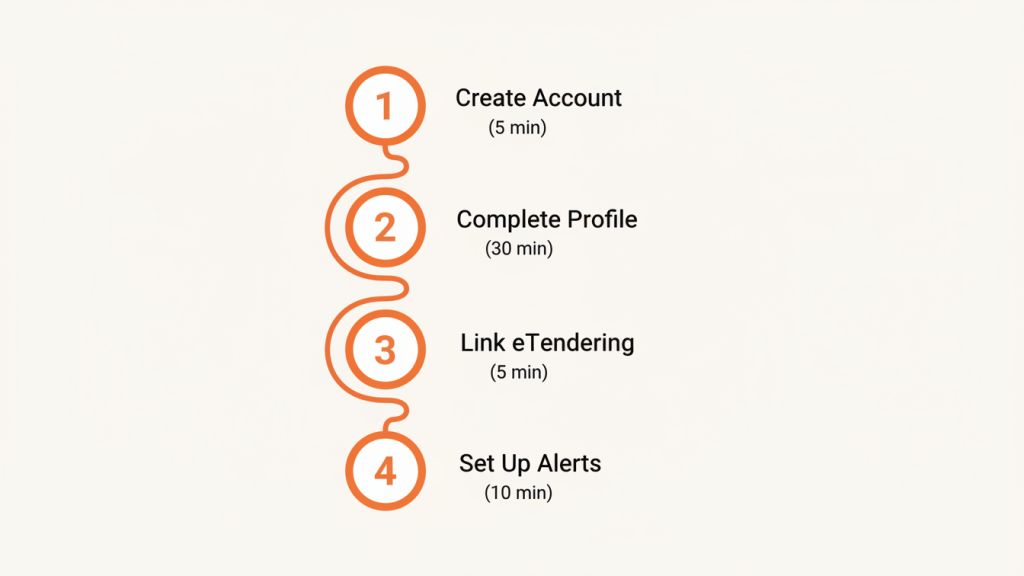
What Are the Mandatory Registration Steps?
Step 1: Create buy.nsw account (5 minutes)
- Go to suppliers.buy.nsw.gov.au
- Enter email, password (minimum 11 characters, including capital, number, symbol)
- Verify via email link
Step 2: Complete Supplier Profile (15–30 minutes)
- ABN verification (auto-populates from ABR)
- Contact details and business address
- Products/services categories (use UNSPSC codes)
- Add team members who need portal access
Step 3: Link eTendering account (5 minutes)
- Existing eTendering users: Sync your profiles through account settings
- New users: Auto-granted access after Supplier Hub registration
Step 4: Set up ProcureAlert (10 minutes)
- Select UNSPSC categories matching your services
- Choose specific agencies you want to track
- Set email frequency (daily works best for active bidders)
Same-day registration to first tender notification is realistic.
Can You Respond to Tenders Without Prequalification?
Yes. Most open tenders don’t require prequalification.
But these schemes do:
- Construction Consultant Services
- Engineering Services
- ICT Services (2020 panel is locked — no new entrants)
- Performance and Management Services
Prequalification speeds future bids. Not having it doesn’t exclude you from open processes. A Parramatta civil contractor I worked with won their first $800K tender without prequalification — they joined the Construction Consultant scheme afterwards.
What Are the NSW Government Tender Thresholds?
Different dollar amounts trigger different rules. Get these wrong, and you’ll either miss opportunities or waste time on tenders you can’t win.
Current Procurement Value Thresholds (2025)
| Amount | What Happens |
| Up to $10K | Direct purchase, any supplier |
| Up to $50K | Direct purchase, SME/regional preferred |
| Up to $250K | SME/regional direct engagement without tender |
| $150K+ | Contract disclosed on eTendering |
| $680K+ | Enforceable Procurement Provisions apply (goods/services) |
| $3M+ | Tenderer must submit SME Participation Plan |
| $7.5M+ | Local market testing mandatory (from January 2025) |
| $9.584M+ | Enforceable Procurement Provisions apply (construction) |
That $250,000 threshold is particularly significant. It was increased from $150,000 in November 2023 under PBD 2023-03, expanding the range of work agencies can award directly to SMEs.
In 2024 alone, more than 1,500 contracts between $150,000 and $250,000 were awarded to SMEs — representing 51% of all contracts in that band. For many suppliers, this is the most commercially realistic entry point into NSW Government work.
How Does the Enforceable Procurement Provisions Direction Work?
For contracts above $680K (goods/services) or $9.584M (construction), agencies must:
- Advertise open tenders on eTendering
- Meet minimum advertising timeframes
- Provide debriefs to unsuccessful tenderers on request
What’s changed: suppliers can apply to the NSW Supreme Court if provisions are breached. Compensation is limited to reasonable tender preparation costs — you won’t recover lost profits, but you can recover the time spent responding.
What Changed in NSW Procurement Policy?
The Minns Government overhauled procurement policy in late 2024. Three changes matter most.
December 2024 Procurement Policy Framework Updates
1. Local Market Testing (PBD 2024-02)
Mandatory for projects $7.5M and above. Agencies must:
- Identify NSW-based suppliers during planning
- Give local suppliers “full and fair opportunity” to participate
- Document “if not, why not” when locals aren’t selected
- Report quarterly (started January 2025)
According to Sparke Helmore’s analysis, “local supplier” means NSW-based enterprise. What counts as “NSW-based” for a Melbourne company with a Sydney office? Still unclear.
2. 30% Tender Evaluation Weighting (legislation pending)
Coming for procurements $7.5M and above. The weighting will cover:
- Local content
- Job creation
- Small business participation
- Ethical supply chains
The Jobs First Commission will oversee enforcement. Public consultation hasn’t started, but expect implementation in 2025.
3. Debarment Regime (in development)
Suppliers with regulatory action or unethical conduct will face exclusion. Timeline TBC.
How Does the SME Direct Procurement Exemption Work?
For contracts up to $250K, agencies can:
- Purchase directly from SMEs without formal tender
- Still must demonstrate value for money
- Insurance confirmation moved to post-award (less upfront paperwork)
Definitions that matter:
- SME: Up to 200 employees
- Regional supplier: Business address outside Sydney, Newcastle, or Wollongong
What Evaluation Criteria Do NSW Agencies Use?
Price matters. But it’s rarely the deciding factor.
Standard Evaluation Criteria Weightings
| Criteria | Typical Weight | What They Want |
| Technical capability | 25–40% | Experience, methodology, team qualifications |
| Value for money | 20–35% | Total cost of ownership, not just price |
| SME/local participation | 10% min ($3M+) | Subcontracting plans, local suppliers |
| Social/environmental | 5–15% | Economic, ethical, environmental priorities |
| Price | 15–30% | Competitive, not necessarily cheapest |
The December 2024 change: contracts $3M+ now require a minimum 15% non-price weighting for government priorities. Two-thirds (10%) must specifically address SME participation.
Why Do Tenders Fail Before Evaluation Starts?
Here’s what trips people up. Assessors run compliance checks first. Non-compliant tenders get excluded before anyone reads your brilliant methodology.
Common exclusion triggers:
- Missing attachments (insurances, policies, certifications)
- Exceeding word or page limits
- Late lodgement (eTendering timestamps to the second)
- Unsigned declarations
- Wrong file formats
- Incomplete pricing schedules
Assessors run compliance checks before any evaluation begins. Non-compliant tenders are excluded automatically — regardless of how strong the technical response may be.
Industry estimates suggest around 60% of tender failures occur at this stage. Compliance doesn’t help you win. It simply keeps you in the process long enough to be assessed.
Which NSW Agencies Release the Most Tenders?
Some agencies pump out opportunities constantly. Others tender once a year.
High-Volume State Agency Tender Sources
Transport for NSW — Infrastructure, consulting, operations. Massive capital program.
NSW Health — Medical equipment, facilities management, clinical services. 230+ sites state-wide.
Department of Education — School construction, IT systems, educational resources. Predictable annual cycles.
Department of Customer Service — ICT, shared services, digital transformation. Where the tech work lives.
Regional NSW — Regional infrastructure, primary industries, regional development. Growing focus under current government.
Local Council Procurement Patterns
128 councils. Billions in annual spend. Common tender categories:
- Road maintenance and construction
- Waste management services
- Parks and recreation infrastructure
- Fleet and plant hire
- Professional services (planning, engineering, legal)
Here’s a tip: Local Government Procurement (LGP) operates as a prescribed entity. Councils can buy from LGP panels without separate tenders. Getting on an LGP panel provides ongoing work without tender-by-tender bidding.
How Long Does the NSW Tender Process Take?

Plan for longer than you expect.
Typical Tender Timeline by Contract Value
| Stage | Under $250K | $250K–$3M | Over $3M |
| Tender open | 7–14 days | 14–28 days | 28–42 days |
| Evaluation | 1–2 weeks | 2–4 weeks | 4–8 weeks |
| Contract negotiation | 1–2 weeks | 2–4 weeks | 4–12 weeks |
| Award to start | 1 week | 2–4 weeks | 4–8 weeks |
| Total | 3–6 weeks | 6–14 weeks | 14–28 weeks |
Reality check: Complex procurements can take 6–12 months. Transport for NSW major projects often exceed 12 months from tender close to contract execution.
What Is the NSW Government Payment Terms Policy?
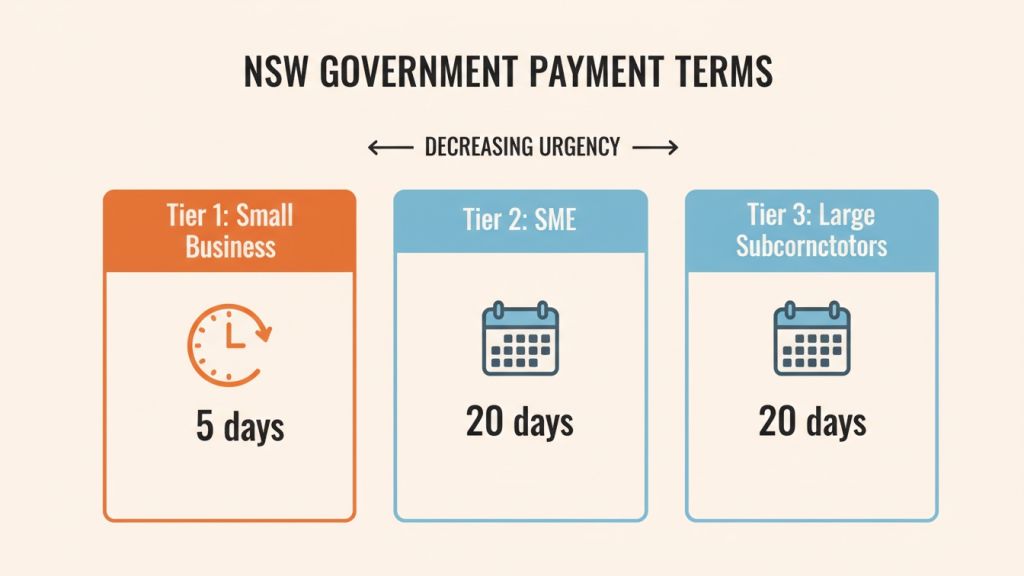
This matters for cash flow planning.
Three tiers:
- Small business (<20 employees): 5 business days for invoices up to $1M
- SMEs (<200 employees): 20 business days
- Large business subcontractors: 20-day payment on contracts $7.5M+ (Small Business Shorter Payment Terms Policy)
The 5-day payment for small business is genuine. I’ve seen invoices paid in 3 days. Make sure your Supplier Hub profile correctly identifies your business size.
Can Interstate Businesses Win NSW Government Tenders?
Yes. But the rules are shifting toward local preference.
What Does “Local Supplier” Mean Under the New Rules?
From January 2025: Local supplier = NSW-based enterprise.
Questions that remain unanswered:
- Does a Melbourne company with a Sydney office qualify?
- How is “NSW-based” verified during evaluation?
- What documentation proves substantive local presence?
Current read: Appears to require genuine NSW presence, not just a registered address. Expect clarification as the Jobs First Commission becomes operational.
Do International Procurement Agreements Still Apply?
Yes. Free trade agreements limit discrimination against foreign suppliers.
But October 2024 amendments to the Enforceable Procurement Provisions removed prohibitions on:
- Requiring local content offsets
- Considering origin of goods and services
Net effect: Agencies have more flexibility to favour local products within treaty constraints. If you’re interstate, demonstrating NSW economic benefit (jobs, suppliers, offices) will matter more than before.
How Do You Find Historical NSW Tender Data?
Past contracts tell you what’s coming next.
Accessing Contract Disclosure Information
NSW eTendering publishes contracts $150K+ within 60 days of award.
Search by:
- Agency name
- Supplier name
- Contract value
- UNSPSC category
- Start and end dates
Limitation: Only contracts above $150K appear. No data on unsuccessful bids or sub-threshold spending. For that, you need Freedom of Information requests — which take 20+ working days.
Using Past Contracts to Find Future Opportunities
Smart strategy:
- Search awarded contracts by your service category
- Note contract end dates
- Calculate re-tender timing (typically 3–6 months before expiry)
- Set ProcureAlert notifications for relevant agencies and categories
A Wollongong facilities management company I know won a $1.2M contract using exactly this approach. They identified the incumbent’s contract ending, built relationships during the final year, and submitted a strong tender when it came up.
What If Your NSW Tender Is Unsuccessful?
Losing hurts. But every loss contains intelligence for the next win.
Requesting and Using Tender Debriefs
Agencies must provide debrief meetings for covered procurements. Always take them.
Questions to ask:
- How did we score against each criterion?
- What were the winning bid’s strengths?
- Where did our response fall short?
- What would improve future submissions?
Take notes. Bring your bid team. Some agencies share score breakdowns; others speak generally. Either way, you’ll learn.
Legal Options for Covered Procurements
For contracts $680K+ (goods/services) or $9.584M+ (construction):
Suppliers can apply to the NSW Supreme Court for:
- Injunction (to pause the process)
- Compensation (limited to tender preparation costs)
Only if Enforceable Procurement Provisions were breached. This isn’t about disagreeing with the outcome — it’s about process failures. Document everything during the tender period.
Should You Pursue This NSW Government Tender?
Not every opportunity deserves a response. Bid/no-bid decisions save thousands in wasted effort.
When to Bid (Checklist)
✅ Contract value matches your capacity
✅ You meet mandatory requirements (insurances, licences, certifications)
✅ You can deliver within specified timeframes
✅ You have reference projects in similar scope
✅ Your price-to-quality ratio is competitive
✅ You can handle 5–30 day payment terms
✅ You have capacity to write a quality response in the time available
When to Pass
❌ Response time is too tight for quality submission
❌ Evaluation criteria weight your weak areas heavily
❌ Incumbent has strong relationship and clean track record
❌ Contract terms include unacceptable risk transfer
❌ Resources required exceed potential return
❌ You’re bidding just to “get your name out there”
That last point matters. Agencies track bid quality. Submitting weak tenders damages your reputation more than staying quiet.
Your Next Move
The opportunity is real: $42 billion in annual spend, with $10.1 billion already flowing to SMEs.
But opportunity without preparation leads nowhere.
Start with the basics. Register on the Supplier Hub. Set up ProcureAlert for your service categories. Review awarded contracts in NSW eTendering and track expiry dates. Build your local content narrative now, before the new evaluation weightings fully take effect.
If your capability statement isn’t ready for government scrutiny, that’s the real starting point. Agencies form credibility judgments in seconds. A rushed or generic document won’t compete against suppliers who have invested in presenting their capability properly.
If you need support preparing a government-ready capability statement, we specialise in helping Australian SMEs position themselves to win public sector work.
FAQs
Where can I find NSW Government tenders?
NSW Government tenders appear on NSW eTendering for state agencies. From December 2024, all procurements over $150K must also publish on buy.nsw’s Tenders module. For council work, check Local Government Procurement (lgp.org.au) or Tenders.Net. Set up ProcureAlert notifications to receive daily emails for your service categories.
How do I register as an NSW Government supplier?
Create an account at suppliers.buy.nsw.gov.au, complete your Supplier Hub profile with ABN verification and service categories, then link your eTendering account. Total time: 30–45 minutes. Registration became mandatory from 1 July 2024 for contracts exceeding $150K.
What is the SME procurement threshold in NSW?
Agencies can directly engage SMEs for contracts up to $250K without formal tender (increased from $150K in November 2023). SME is defined as Australian or New Zealand business with fewer than 200 full-time equivalent employees. In 2024, over 1,500 contracts in the $150K–$250K range went to SMEs.
Do I need prequalification to bid on NSW tenders?
No. Most open tenders don’t require prequalification. Schemes that do include Construction Consultant Services, Engineering Services, and Performance and Management Services. The ICT Services panel (2020) is closed to new entrants. Prequalification speeds future bids but isn’t mandatory for open processes.
How long do NSW Government tenders take?
Tender periods range from 7–14 days (under $250K) to 28–42 days (over $3M). Total process — from tender close to contract start — typically takes 3–6 weeks for smaller contracts and 14–28 weeks for major projects. Transport for NSW procurements often exceed 12 months.
What are the NSW Government payment terms?
Small businesses (under 20 employees) receive payment within 5 business days for invoices up to $1M. SMEs (under 200 employees) receive payment within 20 business days. For contracts $7.5M+, large business prime contractors must pay small business subcontractors within 20 days.
What changed in NSW procurement policy in 2024?
Three major changes: (1) Local market testing mandatory for contracts $7.5M+ from January 2025; (2) 30% tender evaluation weighting for local content coming for $7.5M+ contracts; (3) October 2024 amendments removed prohibitions on local content offsets and origin-based considerations.
Can interstate businesses win NSW Government tenders?
Yes. Free trade agreements prevent discrimination. But from January 2025, “local supplier” means NSW-based enterprise for contracts $7.5M+. Interstate businesses should demonstrate substantive NSW presence — employees, suppliers, offices — not just a registered address.
What evaluation criteria do NSW agencies use?
Technical capability (25–40%), value for money (20–35%), price (15–30%), SME/local participation (10% minimum for $3M+ contracts), and social/environmental outcomes (5–15%). Price alone rarely wins. For contracts over $3M, 15% non-price weighting for government priorities is mandatory.
How do I request a tender debrief?
Contact the agency procurement officer listed in the tender documents within 14 days of receiving your outcome letter. For contracts over $680K (goods/services) or $9.584M (construction), agencies must provide debriefs on request. Ask specific questions: How did we score? What did the winner do better?


