


TL;DR
To find tenders in Australia, start with AusTender for federal opportunities (free) and your state’s eTendering portal. The federal government published $99.6 billion in contracts during 2023–24, with SMEs winning 52% by volume.
This guide gives business owners and procurement officers a practical approach for discovering government and private tender opportunities. Many businesses rely only on free portals and miss a significant amount of available work, especially in the private sector.
Key Takeaway
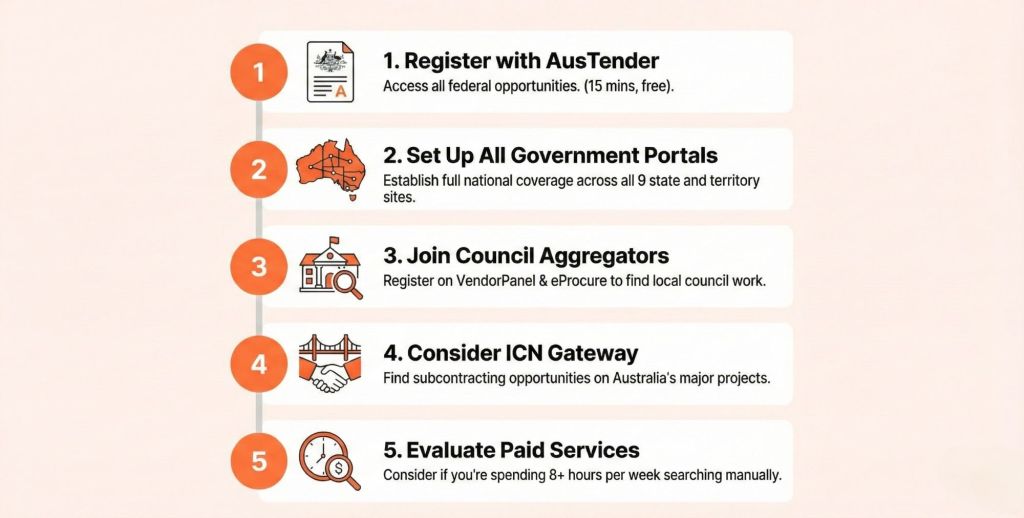
- Register with AusTender (free, 15 minutes, $99.6B in published contracts).
- Set up all nine government portals for full national coverage.
- Consider paid services if you spend 8+ hours weekly on manual searches.
- Use the $500K direct engagement rule to build relationships with agencies.
- New 2025 policy: Contracts under $125K are reserved for Australian businesses.
- Private procurement exceeds $195B annually across major sectors.
- Check the ICN Gateway for subcontracting opportunities on major projects.
Free Government Tender Portals in Australia
Every federal, state, and territory government provides a free tender portal. This covers the majority of public procurement; however, each system operates independently, so visibility depends on registering across all platforms.
AusTender — The Federal Government’s Central Portal
AusTender (tenders.gov.au) is the Commonwealth’s central procurement portal and is completely free to access. Registration takes around 15 minutes and requires your ABN and contact details.
Key features include:
- Access to tender documents and evaluation criteria
- Awarded contract data for competitor and pricing insights
- Annual and Forward Procurement Plans
- Customisable email alerts (category, keyword, agency)
These planning tools are particularly useful for identifying opportunities 12–18 months ahead and preparing early.
State and Territory Tender Portals (Complete List)
Each state and territory runs its own procurement system. The frustrating part? They all work slightly differently. The good part? They’re all free.
Here’s your complete reference:
| State/Territory | Portal Name | URL | Free Alerts |
| Federal | AusTender | tenders.gov.au | Yes |
| NSW | buy.nsw / eTendering | tenders.nsw.gov.au | Yes |
| VIC | Buying for Victoria | tenders.vic.gov.au | Yes |
| QLD | QTenders | hpw.qld.gov.au/qtenders | Yes |
| WA | Tenders WA | tenders.wa.gov.au | Yes |
| SA | SA Tenders & Contracts | tenders.sa.gov.au | Yes |
| TAS | Tasmanian Government | tenders.tas.gov.au | Yes |
| NT | Quotations & Tenders | nt.gov.au/tenders | Yes |
| ACT | Tenders ACT | tenders.act.gov.au | Yes |
Register with all nine portals in one sitting. Yes, it’ll take a couple of hours. But you’ll only do it once, and you’ll have complete coverage of Australian government tender opportunities.
Local Council Tender Opportunities
Local councils play a significant role in public procurement. Their spend covers civil works, facilities management, consulting, IT, waste, landscaping, and more. Because there is no single national portal, council tenders are spread across multiple systems.
Useful platforms include:
- VendorPanel and eProcure: These platforms host tenders for hundreds of councils across multiple states. Free to register as a supplier.
- WALGA Preferred Supplier Program: Covers Western Australian local governments. Once approved, you’re on a panel that councils can draw from directly.
- LG Tenderbox: Aggregates Queensland council opportunities in one place.
- Direct search: Google “[Council name] tenders” to find individual portals. Bookmark the ones in your service area.
But here’s the catch: Council tenders often have shorter response windows—sometimes just 2-3 weeks. If you’re serious about local government work, check your priority councils at least twice weekly.
Paid Tender Notification Services
Here’s a question I get constantly: “Are paid tender notification services worth it?” Short answer: it depends on your time, your target contracts, and your win rate.
When Paid Services Make Sense
Free portals are fantastic—but they have limitations. Paid services fill three specific gaps:
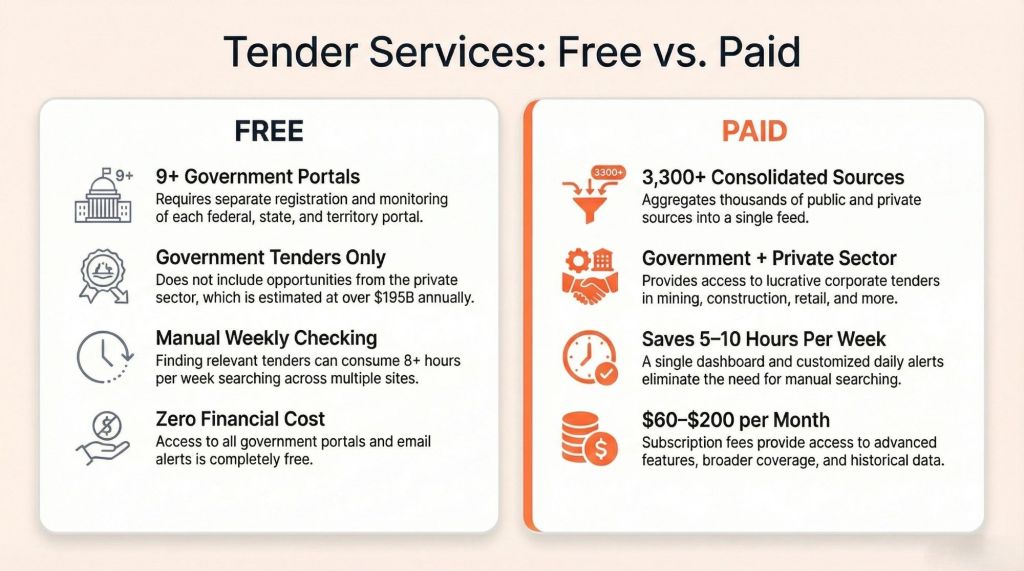
- Time savings: Instead of checking 9+ government portals and hundreds of council sites, you get one dashboard aggregating 10,000+ sources. For a busy BD manager, that’s easily 5-10 hours saved per week.
- Private sector coverage: Government portals don’t list private tenders. If you’re targeting corporate work—mining, retail, construction, subcontracting—you won’t find those on AusTender.
- Historical data: Some services keep 30+ years of awarded contracts. This is gold for pricing intelligence and understanding who wins what.
The ROI calculation is simple:
If one $50,000 contract covers 3-5 years of subscription fees, the service pays for itself. I’ve seen businesses land their first government contract within months of subscribing—contracts they’d never have found manually.
Comparing Australian Tender Services (AUD Pricing)
Here’s how the main players stack up as of late 2025:
| Service | Coverage | Monthly | Annual | Key Features |
| Australian Tenders | AU + NZ | $69-$149 | $690-$1,490 | Daily alerts, watchlist, awarded tenders |
| TenderLink (illion) | AU + NZ | $75-$150 | $750-$1,500 | 946 categories, 3,300+ sources |
| TenderSearch | AU + NZ + Intl | $80-$200 | $800-$2,000 | Dashboard, archives, multi-user |
| Tenders.Net | AU + NZ | $60-$120 | $600-$1,200 | 30+ years history, selective tendering |
| Daily alerts, watchlist, and awarded tenders | Federal only | Free | Free | Email alerts, category matching |
My recommendation: Start with free portals. Track how many hours you spend searching each week and how many relevant opportunities you find. If you’re missing tenders or spending 8+ hours weekly on searches, trial a paid service.
Industry-Specific Tender Platforms
General portals are great, but some industries have dedicated platforms worth knowing about. These can be goldmines if you’re in the right sector.
ICN Gateway — Infrastructure and Major Projects
The Industry Capability Network (ICN) Gateway is where Australia’s biggest infrastructure projects list subcontracting opportunities. We’re talking AUKUS submarines, VicGrid renewable energy, and Northern Water projects.
Registration is free for Australian and New Zealand businesses. Once you’re in, you can:
- Browse upcoming major project pipelines
- Submit Expressions of Interest (EOIs) directly to project teams
- Get matched with prime contractors seeking local suppliers
If you’re in construction, engineering, manufacturing, or professional services for major projects, ICN Gateway should be on your radar.
BuyICT — Digital and IT Services
Tech businesses should know about BuyICT and the Digital Marketplace. These platforms list IT opportunities across federal, state, and local government.
The Digital Marketplace operates on a panel arrangement—once you’re approved, agencies can approach you directly for quotes under certain thresholds. It’s a way to win work without going through full tender processes every time.
Construction and Trade Tenders
Construction businesses have several sector-specific options:
- QBuild eTender: Queensland government construction projects
- Buying for Victoria (construction category): Victorian government building and infrastructure
- Defence construction: Listed on AusTender, often requiring specific security clearances
Defence work, in particular, is worth pursuing if you can meet the compliance requirements. The contracts tend to be larger, longer-term, and there’s less competition due to the barriers to entry.
Private Sector Tender Opportunities
Government isn’t the only game in town. Private sector tenders in Australia represent an estimated $195+ billion annually in procurement spending, according to Global Tenders estimates. That’s almost double the federal government spend.
Where to Find Private Tenders
Private tenders are harder to track because there’s no central portal. Here’s where to look:
- Australian Tenders (australiantenders.com.au): Includes private sector listings alongside government opportunities
- TenderLink: Large corporates publish directly on this platform
- Industry publications: The Australian Financial Review, The West Australian, and sector-specific trade magazines often publish tender notices
Corporate Procurement Opportunities
Major corporates often have their own supplier registration portals:
- Mining: BHP, Rio Tinto, and Fortescue all operate supplier portals. Mining procurement is massive in WA, QLD, and SA.
- Retail: Woolworths and Coles have supplier programs for everything from logistics to marketing services
- Banking and finance: The Big Four banks and major insurers regularly tender for professional services
The approach differs from the government. Private sector buyers care more about relationship, track record, and innovation than compliance paperwork. Get known before tenders drop.
Frequently Asked Questions
Is AusTender free to use?
Yes, AusTender is completely free. Registration requires an ABN, and you can set up unlimited email alerts for matched opportunities at no cost. All federal government tenders above $10,000 are published here. The platform also provides access to awarded contract data and Forward Procurement Plans—also free.
How do I find local council tenders?
Search “[Council name] tenders” to find the direct portal. The easiest method is registering with aggregator platforms like VendorPanel or eProcure, which host tenders for hundreds of councils. In Queensland, LG Tenderbox aggregates council opportunities. In WA, WALGA’s Preferred Supplier Program provides access to local government contracts across the state.
What documents do I need to tender?
Essential documents include: ABN registration, certificates of currency (public liability, professional indemnity), a capability statement, relevant certifications (ISO if required), WHS management systems documentation, and financial statements for larger contracts (typically $500,000+). Keep these updated and ready—tender deadlines don’t wait.
Can I tender for government contracts as a sole trader?
Absolutely. The Australian Government actively encourages SME participation, including sole traders. Sole traders won 52% of federal contracts by volume in 2023-24. The key is demonstrating capability, having appropriate insurance coverage, and meeting compliance requirements for your industry.
Can small businesses win government tenders?
Yes—and there are specific policies to help. The Commonwealth Procurement Rules mandate that 25% of contracts by value go to SMEs, and 40% of contracts up to $20 million. SMEs can also be directly engaged for contracts up to $500,000 without an open tender. The 2025 policy changes reserve contracts under $125,000 exclusively for Australian businesses.
How much do tender notification services cost?
Paid tender services in Australia typically range from $60-$200 per month, or $600-$2,000 annually. Australian Tenders starts at $69/month, TenderLink at $75/month, and TenderSearch at $80/month. Most offer tiered pricing based on features and the number of users. All major services offer free trials—test before you commit.
What is the best tender website in Australia?
For government tenders, AusTender (free) is the essential starting point for federal opportunities. For comprehensive coverage, including states and the private sector, paid services like Australian Tenders or TenderLink aggregate 3,300+ sources. The “best” depends on your sector, budget, and whether you need private tender listings.
Are there free tender alerts in Australia?
Yes. Every government portal offers free email alerts: AusTender (federal), plus all eight state and territory eTendering sites. You can configure alerts by keyword, industry category, or agency. The limitation? You’ll need to register with each portal separately—and they don’t cover private sector tenders.
Conclusion
So, what’s your next move?
Finding tenders in Australia comes down to three things: knowing where to look ($99.6 billion published on AusTender alone), understanding the rules that favour SMEs (52% of contracts by volume), and building a system that catches opportunities before deadlines pass.
Start with AusTender registration—15 minutes, free, and you’re plugged into federal government procurement. Then work through the state portals. If you’re spending more than 8 hours weekly hunting for opportunities, trial a paid aggregation service.
The businesses that win government work aren’t necessarily the biggest. They’re the ones who show up prepared, meet compliance requirements, and respond before deadlines. Now you know exactly where to find those opportunities.
Your first tender submission could be next week. What are you waiting for?


