


TL;DR
Tender value is the total estimated dollar amount of a government contract opportunity.
In Australia, this figure determines whether contracts get publicly advertised, what compliance you’ll need, and how competitive the bidding process will be.
Federal thresholds start at $125,000 for goods and services, while state thresholds typically sit around $250,000. Understanding these numbers helps you target winnable opportunities and avoid wasting time on contracts that don’t match your business capacity.
Key Takeaways
- Tender value is the maximum estimated cost of a contract over its entire life — including options, extensions and renewals
- Federal thresholds: $125,000 (goods/services), $400,000 (corporate entities), $7.5 million (construction)
- State thresholds: Generally $250,000 for goods/services across most states
- Below threshold: Agencies can use direct purchasing — opportunities often aren’t advertised
- Above threshold: Mandatory open tender with public advertising on AusTender or state portals
- Your capability statement should scale with the contract values you’re targeting
What Is Tender Value?
Tender value refers to the total estimated cost of a procurement over the entire life of the contract.
It’s not just the upfront price tag. It includes everything the government expects to spend — options, extensions, renewals and any other mechanisms that might be exercised during the contract period.
Think of it as the maximum potential spend, not the minimum guaranteed amount.
But here’s where people get confused.
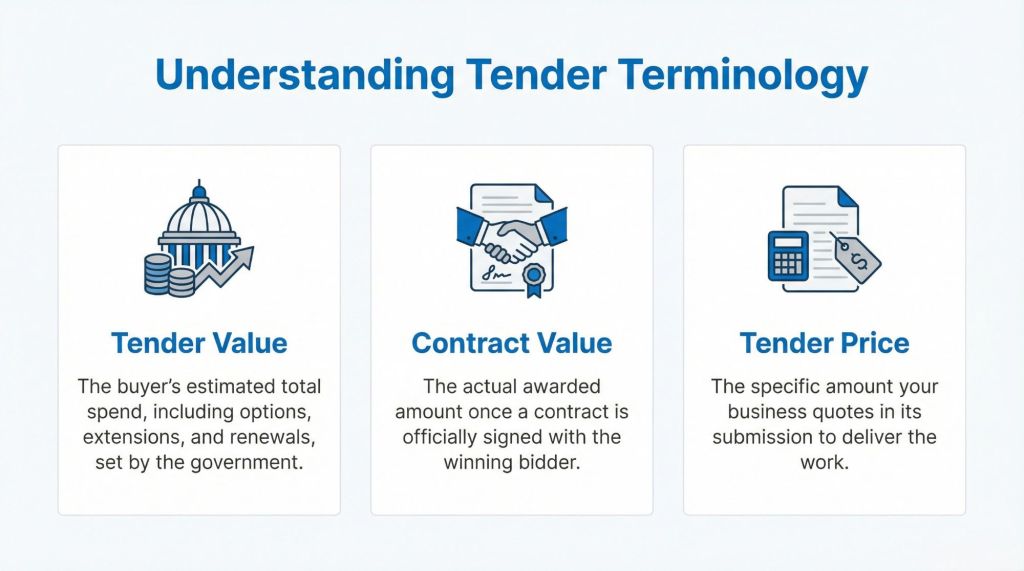
Tender value, contract value and tender price are three different things:
- Tender value: The buyer’s estimated total spend (set by the government agency)
- Contract value: The actual awarded amount once a contract is signed
- Tender price: The amount you quote in your submission to deliver the work
When a procurement officer estimates tender value, they’re figuring out which rules apply to the purchase. Your job as a tenderer is to understand what that value means for competition levels, compliance requirements and your realistic chances of winning.
How Is Tender Value Calculated?
The Commonwealth Procurement Rules set out exactly how agencies must calculate estimated value.
It’s not a rough guess. Agencies must include:
- All forms of remuneration (premiums, fees, commissions, interest, allowances)
- The value of goods and services being procured
- Any options built into the contract
- Taxes and charges
- Ongoing costs over the contract term
Here’s where it gets interesting.
When a procurement runs in multiple parts — with contracts awarded at the same time or over a period — agencies must add up all parts to determine total value.
This stops agencies from splitting contracts to avoid threshold rules.
And if the value genuinely can’t be estimated? The procurement must be treated as if it’s above the relevant threshold. No shortcuts allowed.
Why Tender Value Matters for Australian Businesses
Let’s be direct. Tender value affects your business in four critical ways.
1. It determines how contracts get awarded
Above certain thresholds, agencies must run open competitive processes. Below those thresholds, they have the flexibility to purchase directly or seek limited quotes.
This means many lower-value opportunities never appear on tender portals. They’re handled through existing relationships and direct approaches.
2. It sets your compliance requirements
A $50,000 contract requires basic documentation. A $5 million contract requires detailed methodology, financial capacity evidence, insurance certificates and possibly security clearances.
The higher the value, the more you’ll need to demonstrate.
3. It affects competition intensity
Higher-value contracts attract more competition. A $500,000 opportunity might draw 15 submissions. A $50,000 contract might attract three or four.
But don’t assume smaller is always easier. Sometimes the big contracts have less competition because fewer businesses can meet the requirements.
4. It guides your targeting strategy
Not every opportunity suits every business. A sole trader shouldn’t chase $10 million infrastructure projects. An established contractor shouldn’t waste time on $20,000 quotes.
Understanding value thresholds helps you find your sweet spot.
Australian Government Tender Value Thresholds
Now we’re getting to the practical stuff.
Procurement thresholds determine when agencies must advertise opportunities publicly and follow formal competitive processes. These numbers vary between federal, state and local government.
Commonwealth (Federal) Government Thresholds
The federal government updated its procurement thresholds in recent years. Here’s where they currently sit:
| Entity Type | Goods & Services | Construction |
| Non-corporate Commonwealth entities | $125,000 | $7.5 million |
| Prescribed corporate Commonwealth entities | $400,000 | $7.5 million |
| Reporting threshold (all contracts) | $10,000 | $10,000 |
What does this mean practically?
For most federal opportunities, if the estimated value exceeds $125,000, the agency must conduct an open approach to market. They’ll publish on AusTender and follow Division 2 of the Commonwealth Procurement Rules.
Below $125,000, agencies have discretion. They might seek quotes from a few suppliers, use an existing panel, or approach someone directly.
All federal contracts above $10,000 are published on AusTender after award, which makes the database a useful tool for researching pricing benchmarks and understanding buying patterns. You can research these awarded contracts to understand pricing benchmarks and identify which agencies buy what you sell.
There are also SME-specific exemptions. Agencies can use a limited tender for procurements up to $500,000 when purchasing from small and medium enterprises. This policy encourages the government to buy from Australian SMEs where possible.
State and Territory Government Thresholds
Each state sets its own procurement thresholds. Here’s the current landscape:
| State/Territory | Goods & Services | Construction Works | Primary Portal |
| New South Wales | $250,000 | $1 million | Buy.NSW |
| Victoria | $250,000 | $1 million | Buying for Victoria |
| Queensland | $250,000 | $1 million | QTenders |
| Western Australia | $250,000 | $2 million | Tenders WA |
| South Australia | $220,000 | $9 million | SA Tenders |
| Tasmania | $250,000 | $1.5 million | Tas Tenders |
| Northern Territory | $500,000 | $1.5 million | NT Government |
| ACT | $250,000 | $1.5 million | Tenders ACT |
Notice the pattern?
Most states align at $250,000 for goods and services. But construction thresholds vary significantly — from $1 million in NSW to $9 million in South Australia.
If you’re in construction, these differences matter. A project worth $3 million might require open tender in Queensland but could be directly sourced in South Australia.
Local Council Tender Thresholds
Here’s something many businesses overlook.
Local councils often have lower thresholds than state governments — typically between $150,000 and $250,000.
The exact number varies by council. A large metropolitan council might set higher thresholds than a small regional shire.
How do you find out?
Check the council’s procurement policy. Most publish these on their website under “Business” or “Tenders” sections. The Office of Local Government in each state also provides guidance on procurement requirements.
Why does this matter?
Local government can be an excellent entry point for businesses new to tendering. Contract values are often smaller, competition less intense, and relationships easier to build.
How Tender Value Affects Procurement Method
The threshold isn’t just a number. It fundamentally changes how procurement works.
Below Threshold: What Happens
When a procurement falls below the relevant threshold, agencies have flexibility.
They might:
- Request quotes from three suppliers
- Purchase directly from an existing panel
- Approach a known supplier without competition
- Use a simple purchase order
The key point? These opportunities often don’t get advertised publicly.
If you’re only watching tender portals, you’re missing a significant chunk of government spending. Below-threshold work happens through relationships, panels and direct approaches.
This is where your networking matters. Attending industry events, meeting with agency procurement teams, and getting onto standing offer panels all open doors to work that never hits the public market.
At or Above Threshold: Open Tender Requirements
Once a procurement crosses the threshold, the rules tighten.
For federal procurements above $125,000, agencies must:
- Publish an open approach to market (usually on AusTender)
- Allow minimum response timeframes (typically 25 days, or 40 days for complex requirements)
- Disclose evaluation criteria in tender documentation
- Treat all tenderers fairly and without discrimination
- Report the awarded contract publicly
State governments follow similar principles, though specific timeframes and requirements vary.
What’s the difference between open and limited tender?
An open tender is publicly advertised — anyone meeting the requirements can submit. A limited tender (sometimes called selective or invited tender) only goes to suppliers the agency approaches directly.
Limited tender above threshold is only permitted in specific circumstances: emergencies, sole suppliers, failed previous tenders, or certain SME exemptions.
Which Tender Values Should You Target?
Not all opportunities are created equal. And not all opportunities suit your business.
Here’s how to think about targeting based on your experience level.
New to Government Tendering (0–2 Years Experience)
Target range: $50,000 – $250,000
When you’re starting out, smaller contracts make sense.
Focus on:
- Open tenders that don’t require extensive past performance evidence
- Requests for Quotation (RFQs) which are simpler to respond to
- Local council opportunities where relationships develop faster
- Panel arrangements that get you in the door for future work
Your goal isn’t to win the biggest contract. It’s to build a track record you can reference in future submissions.
Pro tip: Win three or four smaller contracts with strong delivery. Those case studies become your ammunition for larger opportunities later.
Building Your Reputation (2–5 Years Experience)
Target range: $250,000 – $1 million
Now you’ve got runs on the board.
Start pursuing:
- Selective tender invitations based on your growing reputation
- Prequalification panels at state and federal level
- Multi-year contracts that provide revenue stability
- Subcontracting opportunities on larger projects
At this stage, balance is key. Don’t abandon the smaller work that got you here. But start stretching into mid-value opportunities where you can demonstrate capability.
Established Supplier (5+ Years Experience)
Target range: $1 million+
With a solid track record, you can compete for major contracts.
Focus on:
- Selective tenders where your reputation precedes you
- Two-stage procurement with early contractor involvement
- Strategic partnerships and joint ventures for very large projects
- Long-term panel positions with major agencies
How do you win bigger government tenders?
It’s not just about price. At higher values, agencies weight non-price factors heavily — methodology, team capability, risk management, past performance.
Your submission quality matters more than ever. And your capability statement needs to demonstrate you can handle the scale.
Tender Value and Your Capability Statement
Your capability statement should match the contract values you’re pursuing.
Here’s the thing: a capability statement for a $50,000 contract looks different from one targeting $5 million opportunities.
For lower-value contracts (under $250,000):
- Keep it concise — 2 to 4 pages
- Focus on relevant experience and qualifications
- Include essential insurance and compliance certifications
- Highlight responsiveness and local presence
For mid-value contracts ($250,000 – $1 million):
- Expand to 4 to 8 pages
- Add detailed case studies with measurable outcomes
- Demonstrate financial capacity
- Include organisational structure and key personnel
- Show quality management systems
For high-value contracts (over $1 million):
- Comprehensive document — 8+ pages
- Multiple detailed case studies at comparable scale
- Financial statements or capacity evidence
- Risk management frameworks
- Sustainability and social procurement credentials
- References from similar-scale projects
The evidence requirements scale with contract value. Procurement teams evaluating a $10 million bid need confidence you can deliver at that level.
Understanding Tender Value on AusTender and State Portals
Tender portals provide valuable intelligence — if you know where to look.
Finding estimated values
Not all tender notices include an estimated value upfront. But many do, especially for larger procurements.
On AusTender, check the “Approach to Market” details. Some agencies include budget ranges or estimated values in the description or attached documentation.
Researching awarded contracts
Here’s where it gets useful.
AusTender publishes contract notices for all federal awards above $10,000. You can search by:
- Agency name
- Supplier name
- Category (UNSPSC codes)
- Value range
- Date range
This data helps you:
- Understand what agencies actually pay for services like yours
- Identify competitors winning similar work
- Spot patterns in procurement timing
- Benchmark your pricing against market rates
Pro tip: Before responding to a tender, search for previous contracts in the same category with the same agency. You’ll get a realistic sense of awarded values and who’s winning the work.
State portals offer similar functionality, though the level of detail varies.
Conclusion
Tender value isn’t just a number on a document. It’s the key that determines how procurement works, what rules apply, and whether an opportunity is realistic for your business.
Understanding Australian government thresholds — $125,000 federally, around $250,000 for most states — helps you target the right opportunities. Below these thresholds, work happens through relationships and panels. Above them, you’re competing in open, publicly advertised processes.
The businesses that win consistently don’t chase everything. They match contract sizes to their capability, build track records progressively, and scale their capability statements to meet evidence requirements at each level.
Start where you can win. Build from there.
Need help creating a capability statement that matches your target contract values? Get in touch to discuss your tendering goals.
Frequently Asked Questions
What is the difference between tender value and contract value?
Tender value is the estimated maximum spend set by the agency before procurement begins. Contract value is the actual awarded amount once a supplier is selected. Tender value determines which rules apply; contract value reflects the negotiated outcome.
What is the tender threshold in Australia?
It depends on the level of government. For federal non-corporate entities, it’s $125,000 for goods and services. Most states set thresholds at $250,000. Construction thresholds are higher — $7.5 million federally, and between $1 million and $9 million at state level.
Why is tender value important?
Tender value determines whether opportunities get publicly advertised, what compliance you’ll need, and how competitive the process will be. Understanding thresholds helps you target realistic opportunities and prepare appropriate responses.
What happens below the procurement threshold?
Agencies have flexibility to purchase directly, seek limited quotes, or use existing panels. These opportunities often aren’t publicly advertised, which is why relationship-building and panel membership matter.
How do I find the value of a tender?
Check the tender documentation for estimated values or budget ranges. For research purposes, search awarded contract notices on AusTender or state portals to see what similar procurements have been worth historically.
Does the lowest price always win a tender?
No. Government procurement focuses on value for money, which includes quality, capability, risk and whole-of-life costs — not just the cheapest price. Higher-value tenders especially weight non-price criteria heavily.


